

Think Halloween is scary? This scorched alien world is a real-life cosmic horror story
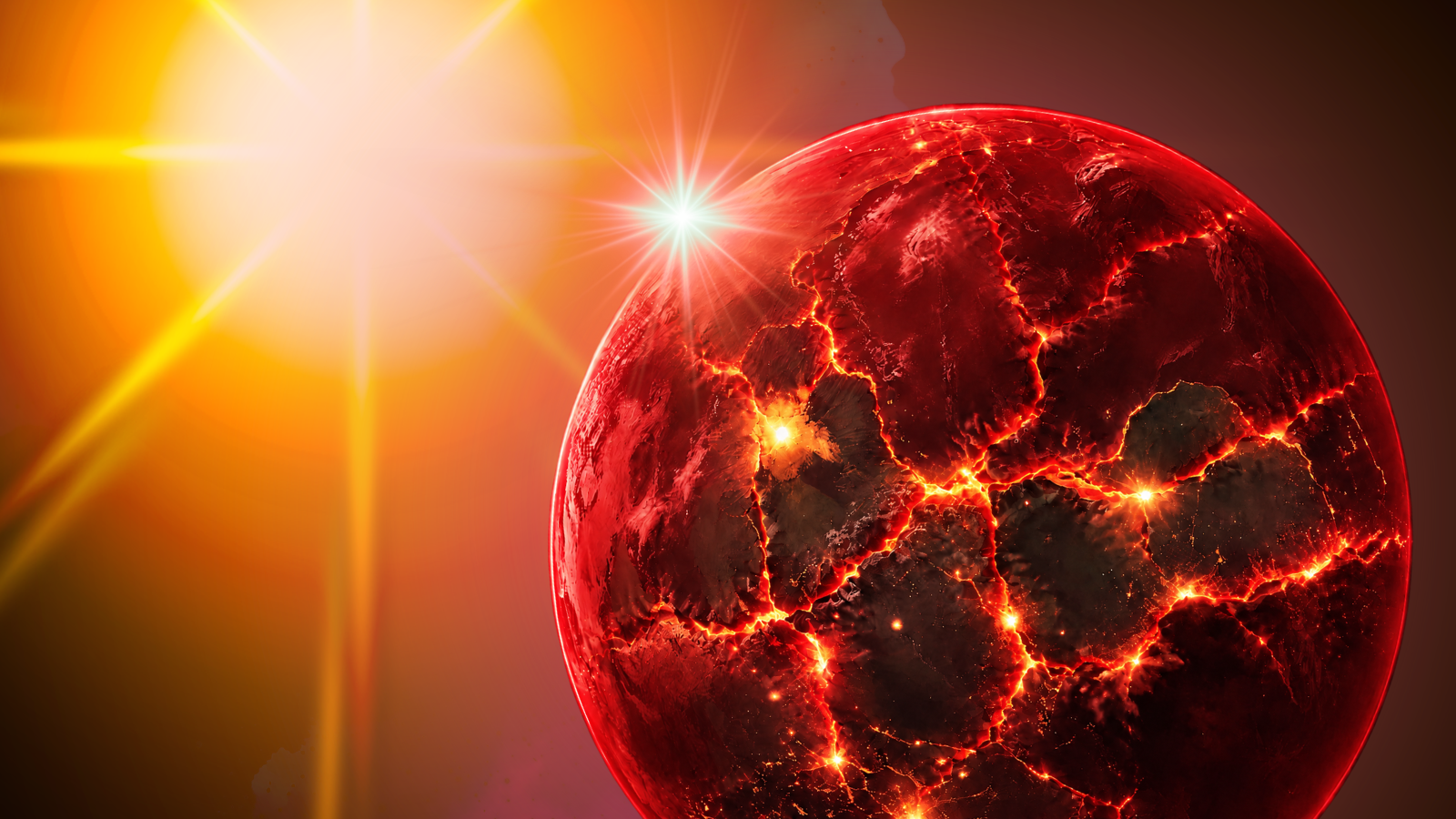
Earth would be terrifying if we celebrated Halloween every 11 hours, a possibility on a super-Earth investigated by the JWST, if it wasn't so hellishly hot that no life could survive on its surface.
Key Takeaways
- Think Halloween is scary?
- This scorched alien world is a real-life cosmic horror story.
- Earth would be terrifying if we celebrated Halloween every 11 hours, a possibility on a super-Earth investigated by the JWST, if it wasn't so hellishly hot that no life could survive on its surface.
Earth would be terrifying if we celebrated Halloween every 11 hours, a possibility on a super-Earth investigated by the James Webb Space Telescope (JWST). That is, if this extrasolar planet, or exoplanet, wasn't so hellishly hot that no life could survive on its surface.The exoplanet in question is the rocky lava planet TOI-561 b, located around 280 light-years away, which was discovered by NASA's exoplanet-hunting spacecraft TESS (Transiting Exoplanet Survey Satellite) in 2020. The planet is located so close to its star, TOI-561, that not only does it complete an orbit every 11 hours, but its surface temperatures reach in excess of 3,000 degrees Fahrenheit (1,800 degrees Celsius).That is so hot that astronomers once believed that TOI-561 b couldn't possibly possess an atmosphere. With 37 hours of JWST observations covering nearly four full orbits of TOI-561, scientists have now found this horrific planet is buried in a reflective layer of vaporized silicate mineral clouds, the same family of compounds that make up quartz and sand. "We measured how the planet's brightness and heat changed throughout its orbit," team member Lisa Dang of the University of Waterloo said in a statement. "This technique, known as a phase curve, revealed that the planet reflects a significant amount of light from its star, and that heat is being redistributed around the planet instead of only on the sunlit side. Together, these point to the presence of an atmosphere."The hemispheres of lava super-Earth are day and nightThe proximity of TOI-561 b to its star has another consequence. The planet is tidally locked, meaning it doesn't turn like Earth. Thus, TOI-561 b has one blisteringly hot "dayside" permanently facing its star, and a cooler "nightside" facing out into space in perpetuity. Dang and colleagues investigated the fact that the bare rock of the dayside seemed to be cooler than should be expected. They theorized that missing heat could be carried around to the night side or the heat may be reflected away before TOI-561 b can absorb it.By using the JWST to observe full orbits of TOI-561 b, the team was able to observe the planet's nightside for the first time. They found it isn't warm enough to account for all the heat missing from the dayside.That means TOI-561 b must reflect roughly three-quarters of the starlight that hits it. That is comparable to the most reflective planet in the solar system, Venus, which reflects around 75% of incident sunlight compared to the 30% reflected by Earth.The team determined that this high reflectivity is the result of clouds of silicate minerals, including silicon dioxide and magnesium silicate, forming on the planet's dayside and acting like sunscreen. These clouds could also help TOI-561 b hang on to an atmosphere.A diagram shows that TOI-561 b and its two exoplanet siblings would fit well within the orbit of Mercury around the sun (Image credit: NASA)Of course, the team can't yet be sure what this atmosphere is composed of. It could be a dense carbon dioxide fog like that seen on Venus, or it could be a blanket of sulfur dioxide like that of the most volcanic body in the solar system, Jupiter's moon Io. That would be the case if, like on Io, volcanic activity is replenishing the atmosphere of TOI-561 b. "The next big question we will seek to answer is whether TOI-561 b's atmosphere resembles Venus or an extreme version of Io," Dang said. "Observing the planet at longer wavelengths with JWST could give us insights and help explain how a planet this hot has held on to an atmosphere for billions of years."The team's research was published in The Astronomical Journal.
Read Complete Original Article
Published originally on Space.com
Related News

Rescue operations on after Indian helicopter crashes in Himalayan state
The aircraft reportedly took off from the Hindu pilgrimage site of Badrinath on Friday afternoon before losing contact.

November’s Night Sky Notes: Light-Day Away
Twin Travelers In 1977, NASA launched twin spacecraft Voyager 1 and 2, taking advantage of a once-every-175-year planetary alignment of the four largest planets in our solar system: Jupiter, Saturn, Uranus, and Neptune. Using six gravity assists between them, this Grand Tour gave us up-close views of the gas and ice giants, including several moons. […]

Scientists confirm fruit and vegetable skin really is good for you
Parts of plants that are usually wasted, from kiwi skin to squash seeds, contain more fibre than the parts of the plant we do eat
All Information In One Place
Real-time headlines from trusted sources. Get the app now — stay updated, inspired, and ahead with breaking news!
