
After a two-year journey, the Hera spacecraft is arriving at the Didymos double asteroid system, and its first images are being released to the public today (Nov. 25).The European Space Agency's (ESA's ) Hera probe launched atop a SpaceX Falcon 9 rocket from Cape Canaveral Space Force Station on Oct. 7, 2024. Its destination is the Didymos-Dimorphos asteroid system, which consists of the larger Didymos, a "rubble pile" asteroid, and its smaller moonlet Dimorphos. NASA slammed a kinetic impactor into Dimorphos in 2022 in the historic DART test, which confirmed that such an impact can alter the trajectory of an asteroid.Hera arrives at Didymos today, and ESA is sharing the first close-up images from the mission in a free online livestream. ESA's livestream starts at 1:45 p.m. ET (1845 GMT) on Wednesday (Nov. 25). Watch it live here, courtesy of the European Space Agency.At Dimorphos, Hera will inspect the wreckage caused by DART (Double Asteroid Redirect Test), humanity's first test of planetary defense. The test was designed to see if the orbit of a threatening asteroid could be altered, taking it off a potential crash course with Earth. A simulation of the impact of DART on Didymos (Image credit: S.D. Raducan)The DART mission succeeded, shortening Dimorphos' orbit by just over 30 minutes, showing that kinetic impacts can indeed alter the trajectories of asteroids. Hera will now show up to the crash scene and study the impact crater left by DART and inspect any changes the collision caused. Scientists are thrilled by the prospects.A series of images captured by the DART spacecraft as it sped to impact the asteroid Dimorphos on Sept. 26, 2022. (Image credit: NASA/JHUAPL)"ESA's Hera mission has arrived to learn the answers we need to know," the mission's principal investigator Patrick Michel said in an ESA statement. "How did the impact change Dimorphos? What is the mass of the asteroid and which of its properties explain its response to DART impact? "Hera is carrying out a thorough investigation ever of a deflected asteroid, packed with scientific firsts, to give us a complete and unbiased picture of humankind's first planetary defense test."A view of Didymos from ESA's Hera spacecraft. (Image credit: ESA)ESA has already shared some of the remarkable images Hera has captured en route to Didymos, including a breathtaking image of both asteroids as Dimorphos cast its shadow on its larger companion in a deep-space double-asteroid solar eclipse.Hera even stopped by Mars on its way to the asteroids, snapping pictures of its moon Deimos.The image shows the Didymos double asteroid system, which consists of the larger Didymos and its moonlet, Dimorphos. In this image, Dimorphos' shadow can be seen on the surface of Didymos. (Image credit: ESA)Hera will remain at the Didymos-Dimorphos system for months, deploying cubesats that will study the asteroids with visible and infrared light cameras and radar instruments. Through Hera, scientists hope to refine planetary defense techniques so that, should the time ever come, humanity has options for defending itself against incoming space rocks like the one that wiped out the dinosaurs 66 million years ago."Through many years of hard work our international collaboration managed to do just that, and for the very highest of intentions: to help make Earth safer," said Hera mission manager Ian Carnelli.
Watch live: Europe unveils 1st close-up views of asteroid Dimorphos after NASA's DART impact
SP
Space.comBy Brett Tingley 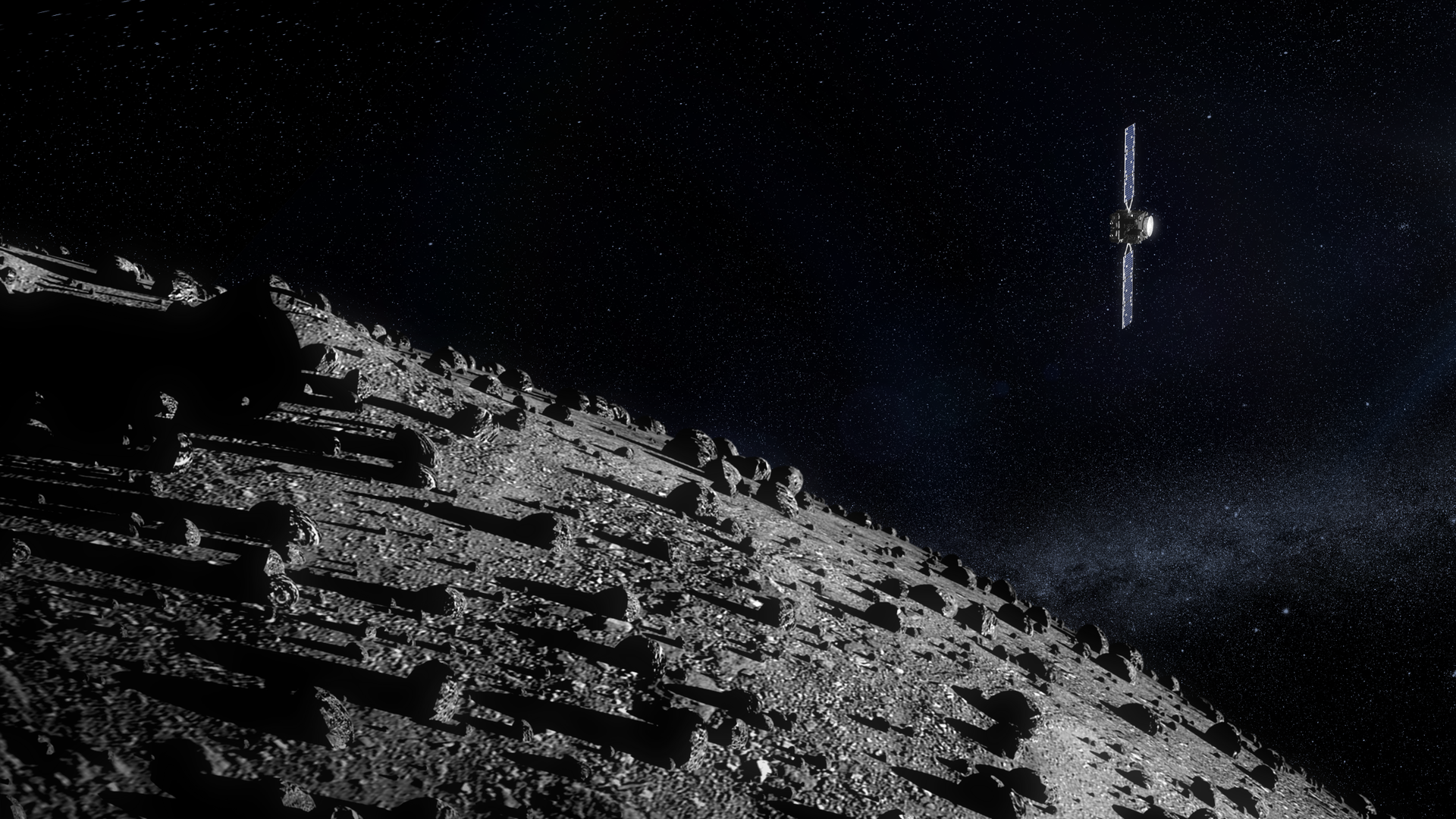
EXECUTIVE SUMMARY
ESA will share the Hera probe's first images of asteroid Dimorphos today following NASA's historic DART mission that impacted the space rock two years ago.
Key Takeaways
- Watch live: Europe unveils 1st close-up views of asteroid Dimorphos after NASA's DART impact.
- ESA will share the Hera probe's first images of asteroid Dimorphos today following NASA's historic DART mission that impacted the space rock two years ago.
- After a two-year journey, the Hera spacecraft is arriving at the Didymos double asteroid system, and its first images are being released to the public today (Nov.
Read Complete Original Article
Published originally on Space.com