It was a showdown worthy of a classic Western, except the things rolling down the street weren’t tumbleweeds. They were robots. On one side of an Old City sidewalk in Philadelphia, an Uber Eats robot trundled along on its daily route. Suddenly, something blocked its path, and it was met face-to-interface with another, new robot. This new bot on the block was wildly different from its utilitarian, food-conveying counterpart: Not only did it have blond hair, blue eyes, and a perpetually lolling tongue, but it also had a name. Meet Orifice the Awebot. Meg Saligman, founder of the Ministry of Awe, an immersive art installation located in a 19th-century Old City bank building, had raced ahead to intercept the bot so Orifice could meet it. According to The Philadelphia Inquirer, Orifice’s creator, Madison Polidoro, then joked that the two robots were “gonna fight!” The Uber Eats robot chose a pacifist approach, steering around its would-be adversary without incident. But Orifice wasn’t created to instigate a territorial dispute between robots. She was made to promote peace between robots and humans, which is no small feat in the City of Brotherly Love. Here, delivery bots aren’t brothers. They’re the “other,” even when they’re bringing you a cheesesteak with Whiz. Since Uber Eats delivery bots made their Philadelphia debut in March, the city has not exactly rolled out the red carpet. Within weeks of the robots’ launch, Philadelphians displayed “the whole spectrum” of reactions, according to Dr. Philip Dames, an associate professor of mechanical engineering at Temple University in Philly. Most people barely gave them a second glance, but on the extreme end, one robot was kicked over at around midnight, and one was sat on and graffitied with the words, “DESTROY ME PLZ.” Orifice was designed to be a more warmhearted, interactive answer to the joyless functionality of delivery bots. But why are some people compelled to harass delivery bots in the first place? And can a pink potato with a tongue change that? Orifice the Awebot is here to promote peace between robots and humans. Image: Ministry of Awe “Cute, friendly, and human” The Ministry commissioned Polidoro, a Philadelphia-area fine artist and fabricator known as 10 Ton Fetus for her surreal and psychological sculptures, to create a mobile sculpture. After talking it over with her colleagues, she decided to build her own robot, Orifice, as a foil to the Uber Eats bots. “Having run into them, and being horrified by it, I was excited at the prospect of making their archnemesis, a hero of sorts!” she says. “Something perfectly opposite of what they [delivery robots] are.” Polidoro knew that to properly offset the slick, appliance-like look of the Uber Eats bots, she would need to give Orifice plenty of human flourishes. “She had to be cute, friendly, and human,” Polidoro says. “I carefully considered approachability and anchoring points for human connection in her design.” Orifice stands two feet tall and is shaped like a potato. She has pink, weatherproof rubber skin, and large blue eyes that blink regularly and can also be remotely operated. Her dangling tongue, tuft of Troll doll-esque blond hair, and pink ribbon juxtaposed with an occasional top hat give her a quirky, sometimes unsettling charm. And yes, her name is literal: She has what Polidoro calls a “functional orifice” on her rear end, a common feature of the artist’s work. Artist Madison Polidoro’s mobile sculpture, Orifice the Awebot, was even featured on local news. Video: Awebot Leads the Way to the Ministry of Awe | Positively Philly, PHL17 Philadelphia For a city that has officially embraced the grotesque hockey mascot Gritty, which The Guardian has described as “an acid trip of a mascot,” Orifice almost seems like a love letter on wheels. And so far, the reaction to Orifice has been largely positive, Polidoro says. “Most people smile, laugh and record her, asking questions and wanting to know more,” she says. “Occasionally, people are surprised or find her a bit unsettling. But even those people seem curious and lighthearted.” Too cute to kick? Unlike the delivery bots, which Polidoro describes as “something from a science fiction novel,” Orifice seems to hit a sweet spot in terms of adorableness. “She seems to tap into the psychology of cuteness, like a dog or a child, something understood to be precious and innocent,” she says. (Fortunately, Orifice seems to stop short of provoking “cute aggression,” the urge to squeeze something unbearably adorable.) And there truly is a psychology of cuteness. Researchers have found that robots designed with the “baby schema” (big eyes, round faces, and other infant-like features) are perceived as cuter and more trustworthy. Research by Kate Darling, a robot ethicist who studied human/robot interaction at the MIT Media Lab for about 15 years, has also found that names and backstories make people hesitate to hurt robots, Dames notes. But a pretty face can only go so far. “A face alone doesn’t protect a robot,” Dames says. “The Uber Eats rovers have blinking, winking eyes and still got hazed, and a face engineered to look friendly can read as manipulative.” Sometimes making a robot look more human can backfire. Image: Getty Images / Walter Cicchetti And that’s not the only way making a robot more “humanlike” can backfire, according to Dr. Donald Hantula, a professor of psychology and neuroscience at Temple University. He likens it to Star Wars’ beloved beep-bot R2-D2 versus the frequently beleaguered, all-too-humanoid C-3PO. The more a robot resembles us, he suggests, the more likely it is to face the bullying we usually reserve for one another. “The problem is that the more human something becomes, the more we tend to treat it as human-like,” he says. “And we humans have a really terrible history of how we treat fellow members of our species.” So, will Orifice manage to strike the perfect balance between human and machine, serving as an ambassador of goodwill between tech-weary humans and the machines rolling into their neighborhoods? “Probably not,” Hantula says. Behind our beef with bots So, what is driving hostility toward robots on the street? Whatever it is, Philadelphia seems to have a lot of it. In 2015, hitchBOT, a robot built for a social experiment on the kindness of strangers, was found decapitated at the top of Old City’s Elfreth’s Alley. Named after local blacksmith and property owner Jeremiah Elfreth, the alley is considered one of the oldest continuously inhabited residential streets in the United States. The alley’s museum has since hosted events about hitchBOT’s demise that are part commemoration, part celebration, with an annual festival possibly in the works. But hostility toward robots is far from just a Philly thing, or even a delivery bot thing, Dames notes. “I’d expect friction wherever robots enter public space without local say,” he told Popular Science. That invasion of space without public buy-in can be especially challenging on crowded public sidewalks, which robots must share, as Dames puts it, “with kids, dogs, wheelchair users, and tourists, none of whom opted in.” On those packed sidewalks, the robots are, in Hantula’s words, “essentially beer coolers on wheels” and consistently “get in people’s way.” Related 'Ask Us Anything' Stories What happens when driverless cars break the law? The surprising science behind Japan’s vending machine obsession What kind of animal is Gonzo? Can apps really make you fluent in another language? How do garbage trucks work? Do water picks really work? Dentists weigh in. The humble delivery bot stands in for Big Tech Beyond these logistical issues, Dames says, robots on the street are often among the only physical manifestations of the otherwise inaccessible corporate entities they represent. “The robot is the only part of a company a person can physically reach,” he says. “You can’t confront a cloud algorithm or a board of directors, but you can confront the rover on your block.” Facing down delivery bots is precisely what Dr. Carolyn Marvin, a retired University of Pennsylvania communications professor, has been doing. On Oct. 14, Marvin was arrested and cited for disorderly conduct after stationing herself in front of an Uber Eats robot near Reading Terminal Market. It wasn’t the first time she’d blocked the bots on her daily walks. Marvin told KYW Newsradio that she’s protesting “the ruthless way that rich corporations are casting aside human workers.” She says she has no intention of stopping. Fear of the machine Confronting robots may also offer an outlet for modern anxieties about the rapid, seemingly ungovernable ascent of artificial intelligence, which some experts have warned could wipe out humanity within a decade. Some passersby have even been known to yell “clanker,” an insult popularized by Star Wars that has since become an anti-AI slur, at Uber Eats bots. “The physical embodiment gives you a better target in a sense,” Hantula says. “It’s really hard to kick against AI, but it’s like, okay, I see that thing and I can.” And some of it might be simply for show, Hantula notes. “A lot of this I think is also driven by getting social media likes,” he says. Yet some cultures do seem able to coexist peacefully with delivery bots and other robots. In Korea and Japan, for example, robots are viewed as reliable, time-saving helpers, not professional rivals or harbingers of doom. Orifice probably won’t be able to single-handedly repair the troubled history of robot/human relations in America, but perhaps her presence will provide, as her name suggests, an opening. “Sometimes it can be, and needs to be, as simple as a moment of raw discovery and joy, savoring the little things that make us human,” Polidoro says. “I’d like Orifice to bring a piece of that [joy and discovery] to everyone she encounters.” In Ask Us Anything, Popular Science answers your most outlandish, mind-burning questions, from the everyday things you’ve always wondered to the bizarre things you never thought to ask. Have something you’ve always wanted to know? Ask us. The post Why a pink potato-like robot is wheeling around Philadelphia appeared first on Popular Science.
Why a pink potato-like robot is wheeling around Philadelphia
PO
Popular ScienceBy Jennifer Byrne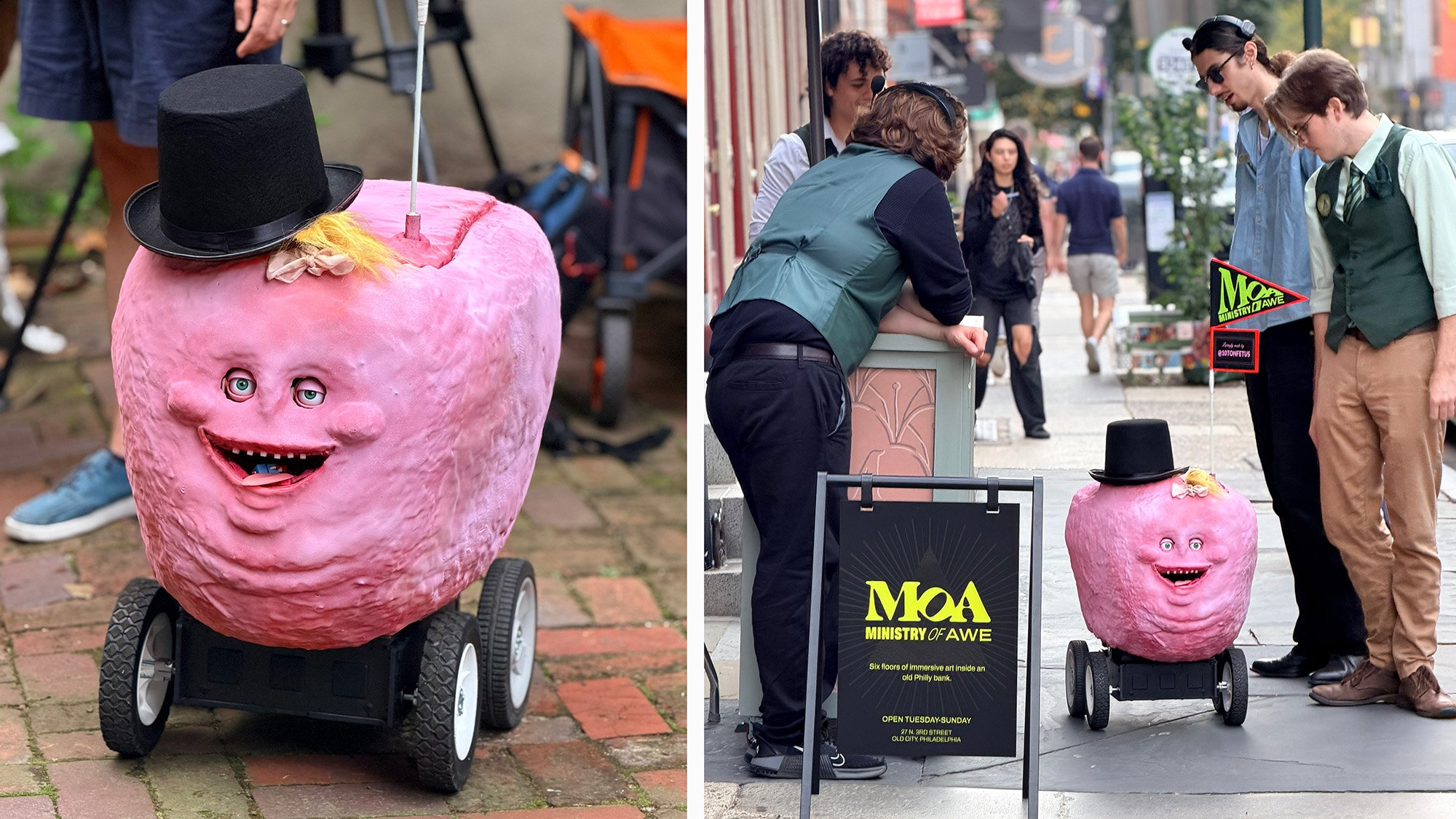
EXECUTIVE SUMMARY
In a city where robots get kicked, graffitied, and decapitated, an artist built a friendlier alternative. Is it enough? The post Why a pink potato-like robot is wheeling around Philadelphia appeared first on Popular Science.
Key Takeaways
- Why a pink potato-like robot is wheeling around Philadelphia.
- In a city where robots get kicked, graffitied, and decapitated, an artist built a friendlier alternative.
- The post Why a pink potato-like robot is wheeling around Philadelphia appeared first on Popular Science.
Read Complete Original Article
Published originally on Popular Science