

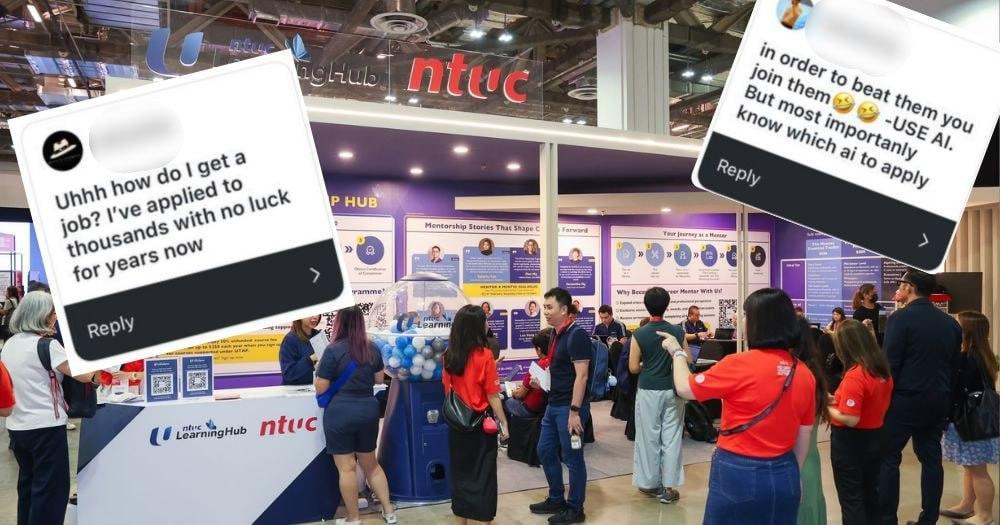
Artificial Intelligence (AI) has already changed the way many people in a range of industries work. “What we are likely to see is not just simply jobs disappearing, but also tasks within jobs changing,” Caryn Lim, NTUC’s Assistant Secretary-General and Chief Job Security told Mothership. “The more important question we could ask is: How can we use AI to make jobs better and help workers remain relevant as work changes?" Long gone are the days when we asked whether AI will change the workplace; we are now solidly at a point in time where we ask what we will have to change about ourselves to adapt to it. Still, it's one thing to know that change is necessary; it’s another in deciding what to change and where to get help doing it. Luckily for us in Singapore, there is help available: look to NTUC, whether it be for support, directions, or advice. Introduced earlier this year, AI-Ready SG is NTUC’s initiative to help workers thrive in an AI-enabled economy. In support of the Tripartite Jobs Council, it offers AI training and upskilling, business and job transformation, and better job matching, so workers can build relevant skills, strengthen their job security and access better opportunities as AI reshapes work in Singapore. We took to Instagram and Telegram to source your questions on AI and the workplace, and then we asked Lim for answers. Here’s what she said: What jobs will AI help sustain/protect? According to Lim, AI is not simply a matter of some jobs disappearing while others remain; rather, it’s a case of AI changing the tasks within jobs, so even jobs that remain, as AI changes industries, may be significantly different. Roles with more routine, administrative or execution-based tasks may experience greater disruption, but this does not mean entire occupations will disappear. Entry-level roles may also change as AI takes on tasks that traditionally helped people learn the ropes. For workers affected by these changes, NTUC’s e2i (Employment and Employability Institute) career coaches can help them take stock of their transferable skills and explore suitable roles or career pathways. Lim said, “By helping workers take on tasks that once required specialist expertise, AI could lower some barriers to entry and enable them to explore a wider range of roles, creating new job opportunities and career pathways. However, this does not remove the need for relevant skills, training or human judgement.” “Employers therefore have a role in redesigning jobs so workers can build experience, take on higher-value responsibilities and continue to progress.” How do I get a job? I’ve applied to thousands with no luck for years Lim acknowledged that applying for jobs without success can be frustrating and discouraging. Understanding where the gap is and what needs changing is key. “Sometimes, it may be about how your skills and experience are being presented. Sometimes, it may simply be that your resume is not getting past the automated applicant tracking systems (ATS) that screen applications before a person sees them." "Sometimes, there may be a skills gap, or you may need to consider adjacent roles where the skills you already have are transferable,” she said. A practical first step is to seek support based on your immediate career needs; NTUC’s e2i offers personalised career coaching to help jobseekers identify suitable roles, present their skills more effectively, and address skills gaps. NTUC’s AI Career Coach is another practical option for people who want digital, on-demand support available at any time of the day - the AI Career Coach can complement human guidance across the job-search journey, from resume support and interview practice to personalised job recommendations and exploration of career pathways in adjacent sectors. Training courses to help you upskill to be future ready are also recommended based on your career goals. Workers who are unsure where to begin can also approach NTUC’s e2i for personalised career guidance and support in identifying their next step while NTUC PME supports Professionals, Managers and Executives in navigating career transitions and workplace change. NTUC’s e2i also organises career fairs and recruitment events that connect jobseekers directly with hiring employers and available opportunities. Jobseekers can access career services at NTUC’s e2i through 28 touchpoints or book an appointment with a career coach here. “If you can’t beat them, join them.” But what AI should I use? “Start with the work, not the tool," Lim advised, referring to the questioner’s profession. “Ask yourself, what is one part of my job where AI could help me work better or more productively?” There are also resources available through NTUC LearningHub to help individuals become more proficient in AI. NTUC members can also use the Union Training Assistance Programme to defray costs for selected AI tools and courses. What type of AI knowledge are companies looking for? Lim once again emphasised that where AI knowledge is concerned, there is no single one-size-fits-all answer, with different jobs and different roles requiring different types and levels of expertise. This is why NTUC seeks to help and guide workers in building AI capabilities that are relevant to their jobs, she said. She offered a piece of advice that seemed to encapsulate her AI advice: “The key is not to learn AI for the sake of learning AI. Learn how to apply AI to solve a real work problem. That is where it becomes valuable.” This sponsored article by NTUC made this writer consider how his own AI education was going.
We asked our readers for all their AI job fears & got NTUC’s Job Security Chief to address them
MO
Mothership SingaporeBy
Branded
EXECUTIVE SUMMARY
From understanding how AI may change your role to getting career coaching, training and job-search support, here’s where to start.
Key Takeaways
- We asked our readers for all their AI job fears & got NTUC’s Job Security Chief to address them.
- From understanding how AI may change your role to getting career coaching, training and job-search support, here’s where to start.
- Artificial Intelligence (AI) has already changed the way many people in a range of industries work.
Read Complete Original Article
Published originally on Mothership Singapore