A new NASA space telescope will study the universe in ultraviolet light to reveal the violent and turbulent events that bubble under what appears to be a cosmic sea of tranquility.The Ultraviolet Explorer (UVEX) mission, developed by NASA in conjunction with the California Institute of Technology (Caltech), will be the first mission to create deep all-sky maps in ultraviolet light. Thus, when it launches in 2031, UVEX will join new sky-mapping surveys like NASA's SPHEREx (Spectro-Photometer for the History of the Universe, Epoch of Reionization and Ices Explorer), which scans the cosmos in infrared, and the Vera C. Rubin Observatory, which does the same over the southern hemisphere in visible light, in creating deep-sky maps across a broad swathe of the electromagnetic spectrum.UVEX's ultraviolet views will reveal explosive events such as the collisions between ultra-dense stellar corpses called neutron stars and the supernova explosions that mark the deaths of massive stars and the births of neutron stars and black holes. Additionally, the NASA ultraviolet telescope should be able to detect a multitude of low-mass galaxies much closer to the Milky Way than similar galaxies that are currently being observed millions and even billions of light-years away by NASA's James Webb Space Telescope (JWST).The $590 million UVEX mission will "advance fundamental frontiers in astrophysics, from understanding the smallest galaxies to diagnosing the aftermath of neutron-star mergers and other cosmic explosions," the mission's principal investigator, Caltech physics professor Fiona Harrison, said in an Oct. 27 statement."The first major ultraviolet space mission in two decades, UVEX is a bold leap forward in our exploration of the ultraviolet universe," Caltech President Ray Jayawardhana said in the same statement. UVEX will paint a picture of cosmic life, death and afterlifeUVEX will benefit from a major leap forward in UV sensitivity thanks to its Caltech-built sensors, which are based on complementary metal–oxide–semiconductor (CMOS) imaging technology. This will help the spacecraft tap into what Harrison described as "the untapped opportunity in the UV."UVEX will be uniquely poised to spot millions of nearby, small, and faint galaxies that are teeming with infant stars that emit bright UV light. "In optical light, it's very hard to distinguish these nearby galaxies from faraway ones that look similar," Harrison said. "UV light will make them easier to find."UVEX won't just be investigating the infancy of stars, however. It will also examine the deaths of ancient stars in the form of supernovas.The supernova relic Pa 30, as seen by the Gemini north telescope. (Image credit: International Gemini Observatory/NOIRLab/NSF/AURA)Supernovas occur when a massive star runs out of fuel for nuclear fusion and can no longer support itself against the inward push of its own gravity. As the core of the star collapses, its outer layers are blasted outward in cosmic explosions we call supernovas.This is a process that scientists are keen to understand, as these explosions fling the heavy elements forged during the stars' lifetimes into surrounding galaxies. This material becomes the building blocks of the next generation of stars, planets, and possibly even life.UVEX will also investigate what happens to the end products of some supernovas, neutron stars, when they meet and merge. An illustration shows two neutron stars colliding and merging. (Image credit: Robert Lea (created with Canva))Neutron stars contain between one and two times the mass of the sun crammed into a width of around 12 miles (20 kilometers). That means they are composed of matter so dense that, if a teaspoon of it were brought to Earth, it would weigh over 1 billion tons. That's equivalent to stacking around 9 million adult blue whales on a spoon.So, when neutron stars in binary systems spiral together and merge, they create an environment so violent that it's the only place in the universe where scientists are sure that elements heavier than lead, like gold, silver, and platinum, are able to be forged. Currently, neutron star mergers are detected via ripples in spacetime called gravitational waves. Scientists can then follow up on the aftermath of the mergers by observing them in electromagnetic light, from high-energy gamma rays to low-energy radio waves. Thus, UVEX will add another aspect to the investigation of neutron star collisions and our understanding of where heavy elements originate. The new space telescope's maneuverability will allow it to observe these explosive events very shortly after they happen, giving it an advantage over other instruments, including NASA's long-serving Hubble Space Telescope."With UVEX, we will now be able to follow up on gravitational-wave events in ultraviolet light," UVEX team member and Caltech scientist Mansi Kasliwal said in the same statement. "I can count on two hands how many spectra we have of transient events in their infancy phase with the Hubble Space Telescope. Hubble is, of course, amazing and does have some ultraviolet capabilities, but it cannot rapidly pivot to observe real-time events."An illustration of a stripped blue star (Image credit: Robert Lea)UVEX will also be revolutionary in the study of blue stars that have had their outer layers of hydrogen stripped away by companion stars. These stars offer researchers a unique opportunity to study the interior of stars, which is usually obscured by their outer layers."We will be able to see what's inside the stars," Kareem El-Badry, an associate professor of astronomy at Caltech and a member of the UVEX team, said in the same statement. "We only know of a small number of stripped stars of this type now. UVEX will find hundreds."All of the above elements discussed are the expected discoveries and investigations that UVEX will be involved with. Perhaps even more exciting, however, are the unexpected elements of the universe it will uncover."Every time you look at the skies in a new wavelength, you learn something new and unexpected," El-Badry said.
NASA's new UVEX space telescope will peer deep into the universe's most violent events
SP
Space.comBy Robert Lea 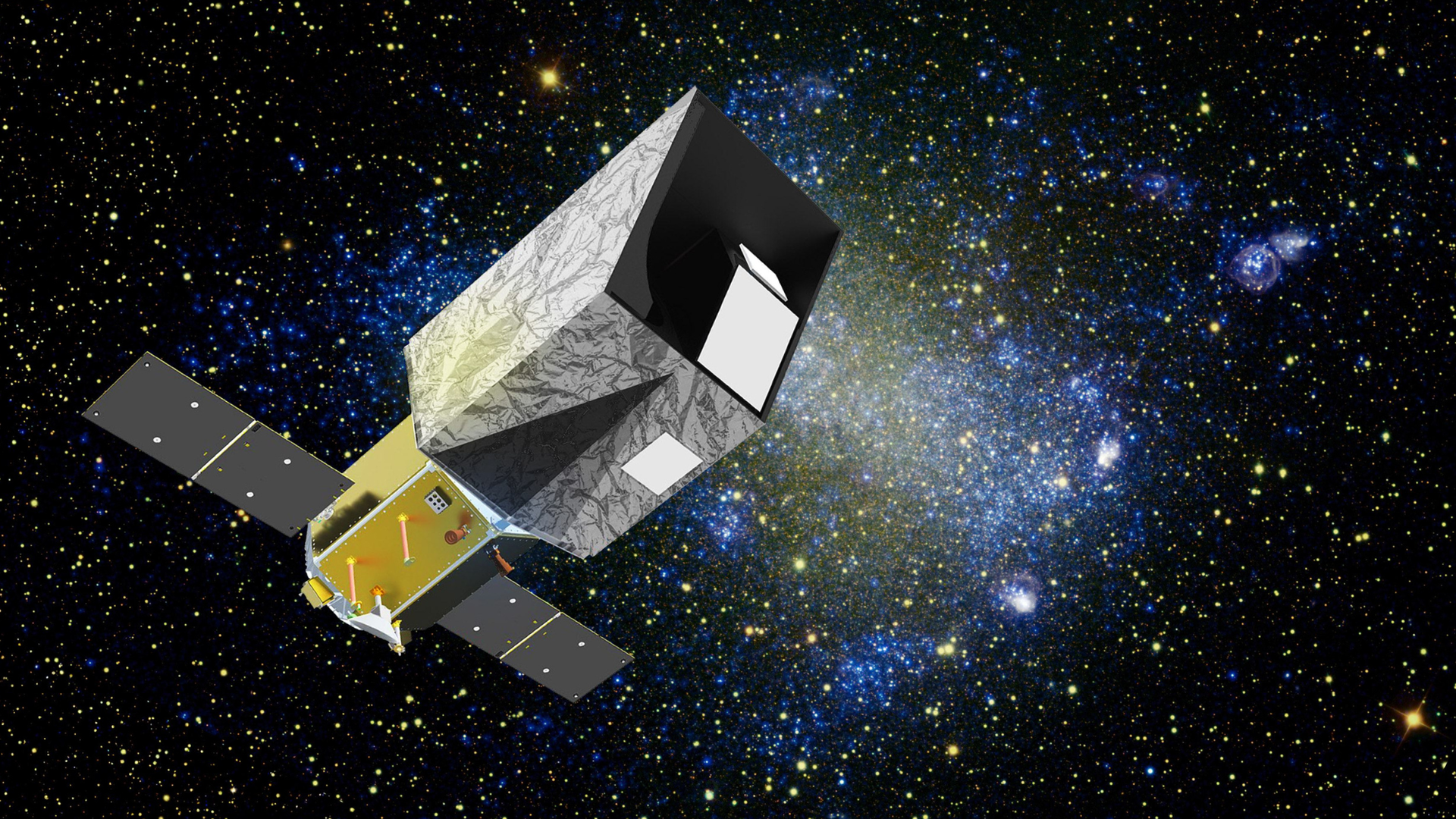
EXECUTIVE SUMMARY
NASA's new UVEX space telescope will study the universe in ultraviolet light to reveal the violent and turbulent events that bubble under what appears to be a cosmic sea of tranquility.
Key Takeaways
- NASA's new UVEX space telescope will peer deep into the universe's most violent events.
- NASA's new UVEX space telescope will study the universe in ultraviolet light to reveal the violent and turbulent events that bubble under what appears to be a cosmic sea of tranquility.
- Additionally, the NASA ultraviolet telescope should be able to detect a multitude of low-mass galaxies much closer to the Milky Way than similar galaxies that are currently being observed
Read Complete Original Article
Published originally on Space.com