Using the Hubble Space Telescope, astronomers have investigated a cosmic cat's tail, finding it likely formed after two Pluto-sized bodies smashed together.The feature, nicknamed the Cat's Tail, extends out from the debris disk known as Beta Pictoris which is located in a planetary system located 63 light-years away. This tail would put that of the average tabby to shame: It's so long that it could curl around the sun-Earth system about 500 times. That's about as long as 200 trillion house cats.The major difference between our solar system and the planetary system that hosts the Cat's Tail is the latter's relative youth. While our solar system is around 4.6 billion years old, Beta Pictoris is a cosmic kitten no more than a few million years old. That means it is still host to collisions between planetary bodies similar to the ones that rocked the solar system during its infancy. The team behind this research gained new insights into the Cat's Tail using 14 years of observations. This allowed them to solve the long-standing mystery of the violent conditions under which it formed. "The Cat's Tail is thought to be the aftermath of a collision between large bodies — think something like Pluto," team leader Arin Avsar of the University of Arizona said in a statement. "Oddly, this feature had previously only been seen with the James Webb Space Telescope (JWST), which detects infrared light, but remained invisible at shorter wavelengths, which has puzzled the community for a while."Cosmic cat tail is also pleasingly fluffyComparing Beta Pictoris and our solar system, one thing rapidly becomes apparent: our cosmic neighborhood is relatively well-ordered. The planets orbit the sun with most space rocks neatly delegated into bands: the main asteroid belt between Mars and Jupiter, and the Kuiper belt out beyond the orbit of Neptune.However, this is a stark contrast to the solar system's violent and chaotic youth. Back then, the solar system was host to an infant star surrounded by a swirling disk of gas and dust in which collisions between bodies called planetesimals — the building blocks of planets — were commonplace.Astronomers can't look back to the solar system's infancy, so to learn more about how our cosmic backyard took shape, they study nearby young planetary systems. Systems like Beta Pictoris. That doesn't mean it has been quick to divulge its secrets, though."We think the Cat's Tail has eluded our observations in visible light until now because of what it's made of," Avsar explained. "It consists almost entirely of what we call organic refractory material, which is heavily carbon-based. These long chains of carbon atoms absorb visible light, so they're quite black."This new study revealed that the feline feature is cat-like in more ways than just its shape. It's also pleasingly fluffy, Hubble observations suggest. That's because the grains that compose it are extremely porous."How you can get dust grains that small that are as porous as we see here no one really understands, and that's part of why we study this feature," Avsar said. "It's possible that the velocities involved in the collisions were so high that the carbon grains vaporized, turned into gas, and then recondensed as they cooled, and that's how they became so porous," team member Kevin Wagner of the U of A said.An illustration of the exoplanet Beta Pictoris b. (Image credit: NASA)The scientists also discovered a hitherto undiscovered feature in the Cat's Tail — a warp that seems to be the result of an interaction between the trail of material and one of the planets in the system, Beta Pictoris b, a gas giant planet 10 times more massive than Jupiter."This gives us another line of evidence into how giant planets influence comets through their immense gravitational force," Avsar said. "It's a testament to how much these massive planets really influence their surrounding dust and icy bodies out to hundreds of astronomical units [one astronomical unit being the distance between Earth and the sun]."The team's research was published last month in The Astrophysical Journal Letters.
Hubble Telescope sees cosmic 'cat's tail' that could wrap around Earth and the sun 500 times
SP
Space.comBy Robert Lea 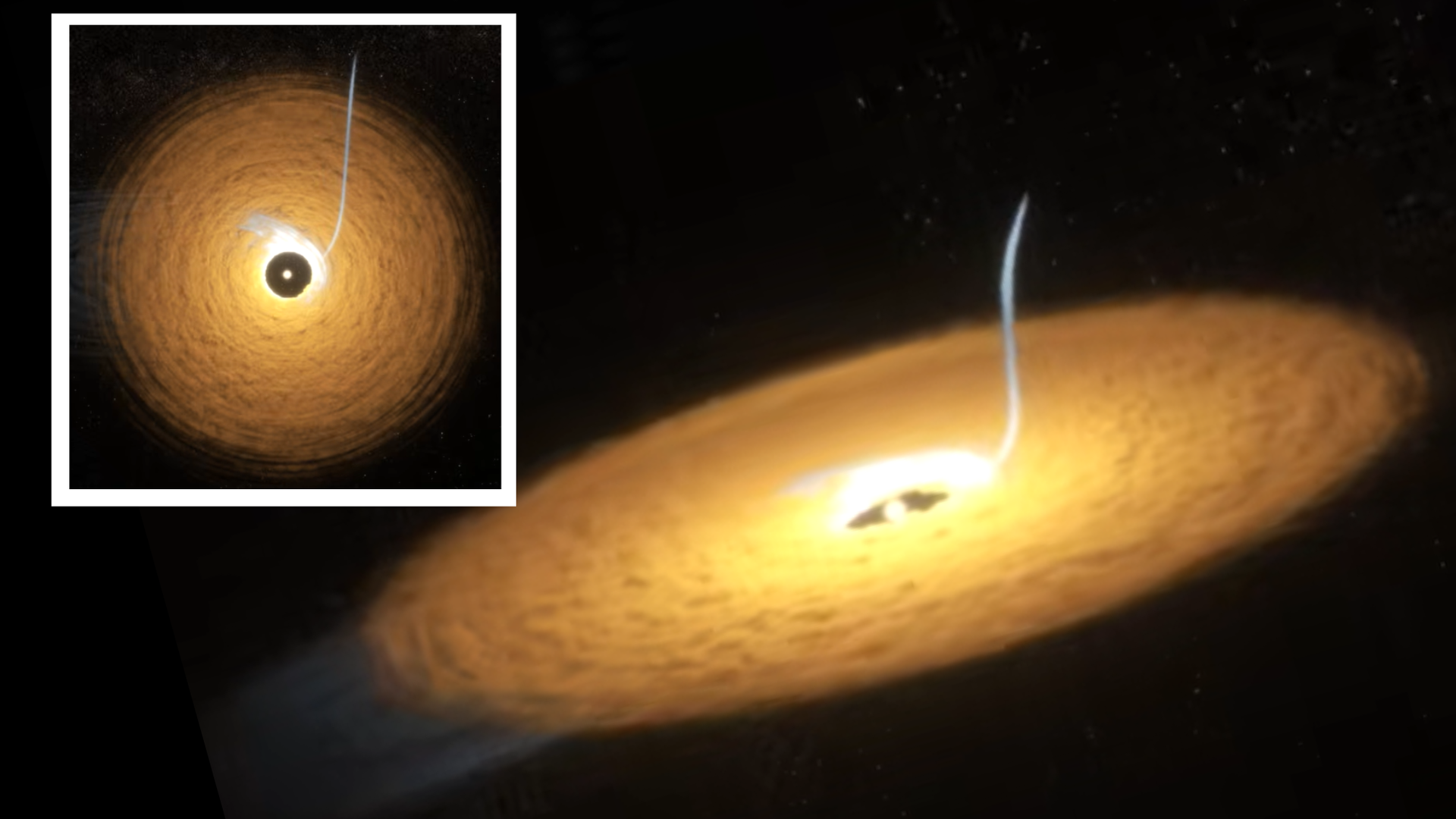
EXECUTIVE SUMMARY
Using the Hubble Space Telescope, astronomers have investigated a cosmic cat's tail formed when two Pluto-sized bodies smashed together.
Key Takeaways
- Hubble Telescope sees cosmic 'cat's tail' that could wrap around Earth and the sun 500 times.
- Using the Hubble Space Telescope, astronomers have investigated a cosmic cat's tail formed when two Pluto-sized bodies smashed together.
- This tail would put that of the average tabby to shame: It's so long that it could curl around the sun-Earth system about 500 times.
Read Complete Original Article
Published originally on Space.com