In March 2023, Midnight Oil frontman and former Labor minister Peter Garrett wrote in an article titled “AUKUS stinks, and that’s an understatement”: Scott Morrison’s decision to build nuclear submarines in partnership with northern hemisphere former imperial powers was the most costly and risky action ever taken by any Australian government and should not have been allowed to stand. It’s little wonder, then, that a Garrett-led community inquiry has this week delivered a report recommending Australia scrap its nuclear-powered submarine program immediately. AUKUS carries significant risk. The question is whether those risks are being adequately mitigated. The report offers little in the way of mitigation beyond recommending Australia cancel its submarine program yet again, at a time when state-on-state conflict is at levels not seen since the second world war. Australia’s strategic circumstances and our responses warrant close scrutiny. There remains a disconnect between how national security professionals understand our strategic circumstances and the public’s understanding of this. The government needs to do more to communicate how the world is changing and what this means for Australia’s security. It must better explain our dependence on maritime trade and why AUKUS is part of the response. Unfortunately, this inquiry fails to do that. Instead, it takes an alarmist approach, demonstrates a limited understanding of maritime strategy, naval capability and defence acquisition, and at times risks spreading misinformation by presenting speculation as fact. What is this inquiry? And what did it recommend? This inquiry was called by members of the community concerned about AUKUS. Of its five commissioners, four had previously criticised AUKUS, including the former defence force chief, Admiral Chris Barrie. The fifth is co-CEO of the Australia Institute, which has publicly campaigned against it. So even at the time it was called, questions were being asked about how independent the inquiry could actually be. As journalist David Speers asked Garrett in June: Do you really need an inquiry when you’ve already made up your mind? To its credit, it invited differing views from former Defence Ministers Kim Beazley, Christopher Pyne and Linda Reynolds, and former Home Affairs Secretary Mike Pezzullo. Yet each is quoted only once in the 113-page report, despite the significance of their experience and differing views. I declined to participate, as did several other colleagues across the defence community, concerned that this public inquiry may have a predetermined view. Instead, my Lowy colleague Sam Roggeveen and I publicly debated our almost diametrically opposed positions on AUKUS. This inquiry held ten days of hearings across Australia and received more than 1,000 submissions. It delivered 17 recommendations – 16 aimed at the government and parliament and one aimed at the broader community. The report notes the government will likely ignore its recommendations. The report made 17 recommendations – 16 for the government and parliament and one aimed at the broader community. AUKUS public inquiry report Of its recommendations, some are hard to disagree with, such as developing a national security strategy. Others seem tangential to AUKUS, including releasing the 2022 intelligence assessment on climate-related national security risks. Other claims are concerning. The report states that the Royal Australian Navy (RAN) “could be forced to act primarily on the orders and in the interests of the US”, without establishing how Australia would lose sovereign control of its submarines. It also asserts that future US Virginia-class submarines “will be nuclear-armed”. It’s true the US is developing a nuclear-armed, sea-launched cruise missile, potentially reviving a Cold War-era capability. But its deployment is far from certain. These risks merit examination, not presentation as certainties. In June this year, a Lowy Institute poll found 68% of Australians supported acquiring nuclear-powered submarines. Cancellation is therefore unlikely in the near term. Yet the inquiry recommends disbanding the Australian Naval Nuclear Power Safety Regulator and AFP (Australian Federal Police) AUKUS Command and ending RAN submariner secondments to US submarines. These recommendations assume AUKUS will be cancelled, with little consideration of how the commissioners’ concerns would be addressed if it continues. If the risks are as grave as the commissioners suggest, wouldn’t they want them mitigated, even if they don’t get their preferred outcome? The report acknowledges nuclear-powered submarines “can travel further and faster, stay underwater longer”. Yet it describes them as primarily offensive platforms unsuited to defending Australia’s maritime approaches. A platform is neither inherently offensive nor defensive. This depends on how it is employed, not its propulsion system. As I have previously argued, most conventional submarines lack the endurance required to operate across Australia’s vast maritime domain and sea lines of communication. No viable replacement Perhaps the report’s most glaring omission is that it offers no viable replacement to AUKUS. It recommends Australia “consider and determine a Plan B for Pillar I”. (Pillar I is Australia’s acquisition of a conventionally-armed, nuclear-powered submarine capability.) Yet the report also states: It is beyond the scope of the inquiry to comment on which alternatives should be pursued. The report insists Australia needs 12 submarines, regardless of type. That figure, first adopted in the 2009 Defence White Paper for a conventional fleet, cannot simply be carried over without considering capabilities, endurance, intended missions and fiscal constraints. Despite Garrett’s previous assertions Australia can buy submarines “off the shelf”, this is simply not true. At the end of the day, AUKUS remains on track, though of course there are significant risks. But the risk of cancelling AUKUS now is that Australia will be left without a submarine capability in the 2030s. AUKUS is not Plan A. It comes after several other plans and projects were abandoned or changed. Cancel another submarine program, particularly one with our closest ally, and it is difficult to see who would be willing to partner with Australia again. Jennifer Parker is a Non-Resident Fellow at the Lowy Institute, an Adjunct Professor (Practice) at the University of Western Australia Defence and Security Institute, an Expert Associate at the Australian National University National Security College, an Adjunct Fellow at UNSW Canberra, and affiliated with the Council on Geostrategy. She is also Principal of Barrier Strategic Advisory, a defence and strategic advisory consultancy. She declined to participate in the inquiry. The views expressed in this article are her own.
Australia needs serious discussion on AUKUS. This inquiry didn’t deliver it
TH
The Conversation - AustraliaBy Jennifer Parker, Adjunct Professor, Defence and Security Institute, The University of Western Australia; UNSW 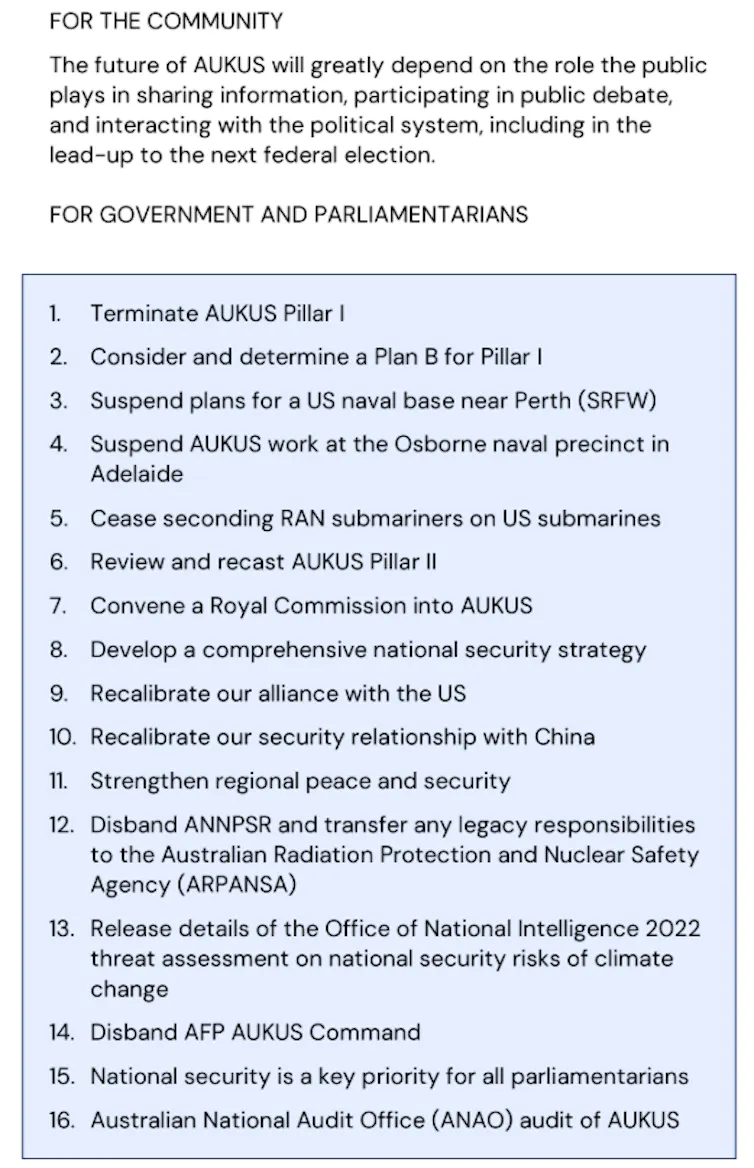
EXECUTIVE SUMMARY
In March 2023, Midnight Oil frontman and former Labor minister Peter Garrett wrote in an article titled “AUKUS stinks, and that’s an understatement”: Scott Morrison’s decision to build nuclear submarines in partnership with northern hemisphere former imperial powers was the most costly and risky action ever taken by any Australian government and should not have been allowed to stand. It’s little wonder, then, that a Garrett-led community inquiry has this week delivered a report recommending Aust
Key Takeaways
- Australia needs serious discussion on AUKUS.
- This inquiry didn’t deliver it.
- It’s little wonder, then, that a Garrett-led community inquiry has this week delivered a report recommending Australia scrap its nuclear-powered submarine program immediately.
Read Complete Original Article
Published originally on The Conversation - Australia