This year marks a rather auspicious anniversary for meteor watchers. Sixty years ago, one of the most stupendous Leonid meteor displays lit up the predawn skies over the central and western U.S. So, what will the 2026 Leonids bring us? And what might they bring in the years to come? The Leonid meteor shower is one of the most celebrated of the year's annual displays of "shooting stars." The mere mention of the Leonids usually elicits mental images of a sky filled with shooting stars pouring down through the sky like rain. Such meteor storms have indeed occurred with the Leonids, such as in 1833 and 1966 when meteor rates of tens of thousands per hour were observed. In more recent years, most notably 1999, 2001 and 2002, lesser Leonid displays of up to "only" a few thousand meteors per hour took place. Unfortunately, that's not likely to be the case this year. In fact, comparatively speaking, this is going to be a lean year for the Leonids chiefly because of the expected lack of any significant activity. Although the Leonids are one of the most famous of all the annual meteor displays, this year they're not likely to be very productive. It's probable they are going to be rather weak and there probably will be long stretches when not a single Leonid will be seen. I'll explain why in a moment. First, let's find out about this shower's lineage. What causes the Leonids?The Leonids are so named because the shower's radiant point, from where the meteors seem to fan out, is located within the constellation of Leo the Lion, from the backward question mark pattern of stars known as "The Sickle." The meteors are caused by the Tempel-Tuttle comet, which sweeps through the inner solar system every 33⅓ years. Each time the comet passes closest to the sun it leaves a "river of rubble" in its wake: a dense trail of dusty debris. A meteor storm becomes possible if the Earth were to score a direct hit on a fresh dust trail ejected by the comet over the past several centuries. The "lion's share" (no pun intended) of comet dust can be found just ahead and trailing behind Tempel-Tuttle. That comet last swept through the inner solar system in 1998. That's why spectacular meteor showers were seen in 1999, 2001 and 2002, with declining numbers thereafter.The most famous depiction of the 1833 Leonids, actually produced in 1888 for the Adventist book Bible Readings for the Home Circle. The engraving is by Adolf Vollmy based upon an original painting by the Swiss artist Karl Jauslin, that is in turn based on a first-person account of the 1833 storm by a minister, Joseph Harvey Waggoner on his way from Florida to New Orleans. (Image credit: Adolf Vollmy - Bible Readings for the Home Circle. Public Domain)When is the best time to look for Leonids?According to the International Meteor Organization's 2026 meteor shower calendar, the Leonids are expected to reach their regular maximum at 23:45 UTC (6:45 p.m. EST) on Nov. 17, with around 15 meteors per hour possible under ideal viewing conditions. Other forecasts place the peak at slightly different times. Margaret Campbell-Brown and Peter Brown, meteor experts for the Royal Astronomical Society of Canada, predict that the peak of this year's Leonids will occur at 00:00 hours UTC on Nov. 18. Russian meteor expert Mikhail Maslov feels that the peak will come about a third of a day earlier, at 16:00 UTC on Nov. 17. Several weaker encounters with older debris trails are also predicted between Nov. 17 and 19, although no major meteor storm is expected.A meteor streaks across the sky above Payson, Arizona during the Leonid meteor shower. (Image credit: mdesigner125 via Getty Images)Hardly any crumbs this year Back in September 2014, comet Tempel-Tuttle was as far from the sun as it can get: 1.84 billion miles (2.96 billion km). The comet has since spent the last dozen years slowly approaching the inner solar system, but it's still 1.11 billion miles (1.79 billion km) from the sun, which is still well beyond the orbit of Saturn. In contrast, at the point in the comet's orbit where we will be passing by on Tuesday morning, there is nothing save for a scattered few particles; bits and pieces likely loosened from the comet's nucleus a millennium or two ago. So, this year's Leonids are expected to show only low activity; "maybe" at best 10 to 15 Leonids per hour might be seen, but more likely hourly counts will be less than that. The moon will not pose a problem; it's at first quarter phase, but it will set before 11 p.m. local time Monday evening, leaving the rest of the night dark.What to look forWatching a meteor shower consists of lying back, looking up at the sky... and waiting. Keep in mind that any local light pollution or obstructions like tall trees or buildings will further reduce your chances of making a meteor sighting. Leo does not start coming fully into view until the after-midnight hours, so that would be the best time to concentrate on looking for Leonids. As dawn is about to break at around 5 a.m., the Sickle will have climbed more than two-thirds of the way up from the southeast horizon to the point directly overhead (called the zenith). Because the Leonids are moving along in their orbit around the sun in a direction opposite to that of Earth, they slam into our atmosphere nearly head-on, resulting in the fastest meteor velocities possible: 45 miles (72 km) per second. Such speeds tend to produce bright meteors, which leave long-lasting streaks or persistent trains in their wake. A mighty Leonid fireball can be quite spectacular, but such outstandingly bright meteors are likely to be very few and very far between this year (if any are seen at all). 1966: Stormy timesIt was a different story 60 years ago, in 1966, when anticipation ran high for a potentially heavy display of Leonid meteors. The previous year, comet Tempel-Tuttle swept around the sun and was accompanied later that year by an unexpected surge of Leonid activity, with brilliant meteors darting across the sky at one or two per minute as seen from Hawaii and Australia. The most sanguine prediction for 1966 came from Dr. Kenneth L. Franklin (1923-2007), chief scientist at New York's Hayden Planetarium. Dr. Franklin had carefully examined the orbit of comet Tempel-Tuttle and concluded that " . . . the position of the comet is roughly what it was in 1833. So, a dramatic shower like the one that occurred in that year may yet be in the offing for 1966."Based on Dr. Franklin's prediction, a "meteor party" was planned for the peak night of the Leonids in Central Park. New Yorkers of all ages were invited to gather on the Great Lawn at midnight to watch for the shooting stars. Ten thousand people turned out, but unfortunately skies were hopelessly cloudy. But across the central and western US, where skies were mostly clear, Leonids were falling at a rate described by many as "too numerous to count." One observer stationed north of Mission, Texas said that meteors falling in all directions gave the impression of a "gigantic umbrella," appearing to "waterfall" out of the head of Leo. Perhaps the best views were from California and Arizona. At the Table Mountain Observatory, near Wrightwood, California, one resident astronomer commented that he and a colleague " . . . watched a rain of meteors, turn into a hail of meteors and finally a storm of meteors, too numerous to count by 3:50 a.m. Pacific Time. Instinctively we sought to shield our upturned faces from imagined celestial debris." From 6,850-foot Kitt Peak in southern Arizona, thirteen amateur astronomers saw Leonids falling at the staggering rate of 40 per second (144,000 per hour)!From Sun, Moon and Stars by Agnes Giberne. (London, 1884). This artwork shows the Leonid meteor storm over Greenwich, London in 1866. (Image credit: Photo by Oxford Science Archive/Print Collector/Getty Images)Looking ahead. . . In 2005, French meteor expert Jeremie Vaubaillon published a technical paper with two colleagues in the journal Astronomy & Astrophysics that forecast Leonid activity for years up to 2100. Sadly, in the year 2029, Jupiter is expected to throw Comet Tempel-Tuttle off its current path through space, making it all but impossible — at least through the beginning of the 22nd century — to see a repeat of the Great Leonid Storm of 1966. But Vaubaillon expects the next big Leonid outburst in the year 2034, when rates could reach up to 2,000 per hour. That's just 8 years from now. Mark your calendars.Joe Rao serves as an instructor and guest lecturer at New York's Hayden Planetarium. He writes about astronomy for Natural History magazine, Sky and Telescope, The Old Farmer's Almanac and other publications.
60 years ago the Leonid meteor shower produced 144,000 meteors per hour. Could it happen again?
SP
Space.comBy Joe Rao 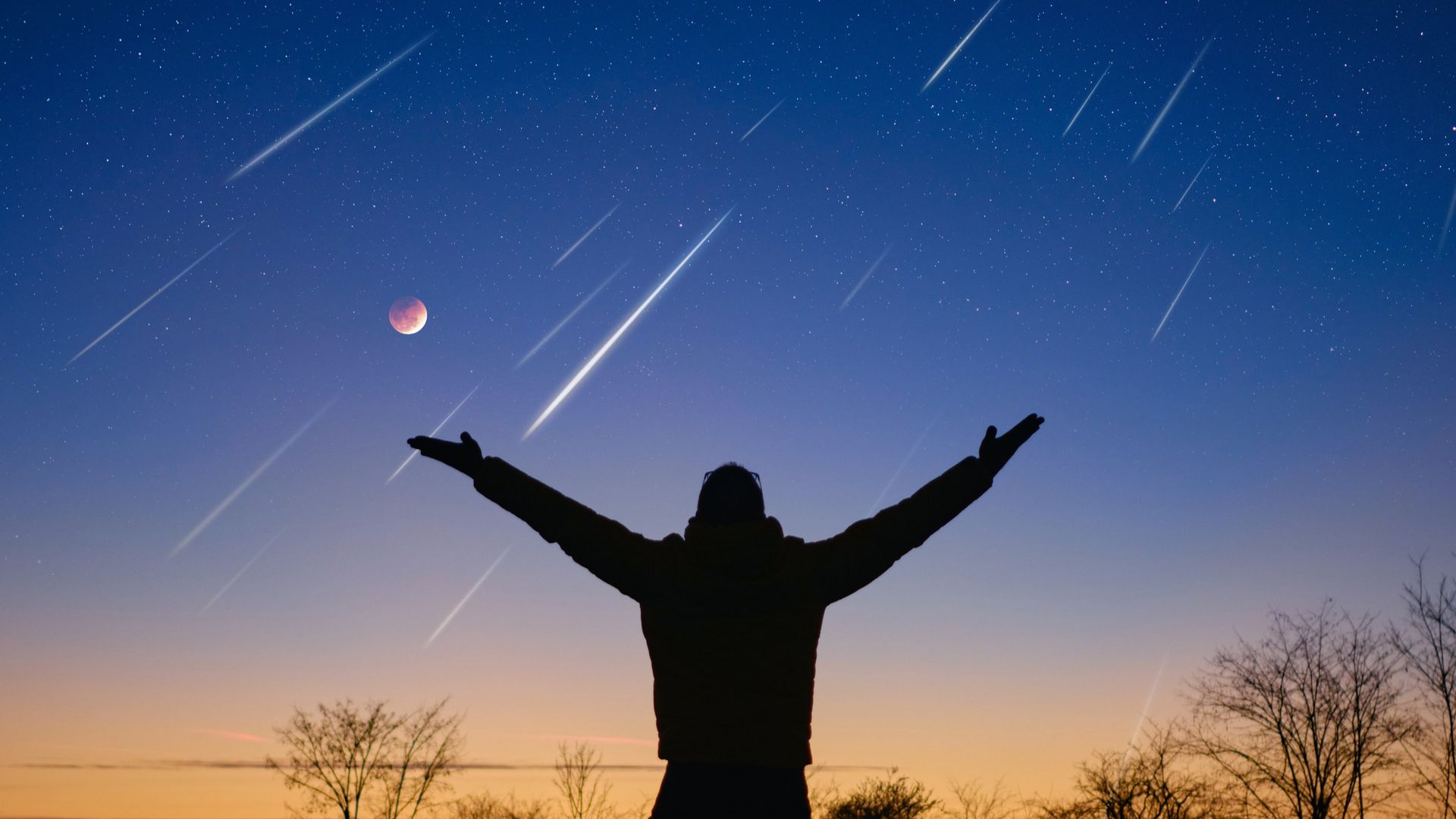
EXECUTIVE SUMMARY
60 years ago, the Leonid meteor shower unleashed one of the most spectacular meteor storms in recorded history. As the 2026 peak approaches, here's what skywatchers can expect.
Key Takeaways
- 60 years ago the Leonid meteor shower produced 144,000 meteors per hour.
- Could it happen again?.
- 60 years ago, the Leonid meteor shower unleashed one of the most spectacular meteor storms in recorded history.
Read Complete Original Article
Published originally on Space.com