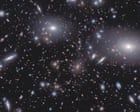
The European Space Agency (ESA) has just released a vast batch of observations of the sky captured by the Euclid space telescope. Launched in 2023, the telescope is currently on a six-year mission to image about one-third of the sky to build the most detailed 3D map of the cosmos ever created. The latest observations – catchily titled DR1-Foundation – cover an area of the sky as big as 9500 full moons. The collection includes 900 million galaxies. ESA/Euclid/Euclid Consortium/NASA, image processing by J.-C. Cuillandre and E. Bertin, CC BY-SA 3.0 IGO This mosaic of 740 images collected in autumn 2024 and spring 2025 covers 367 square degrees of the northern sky. At full resolution, this snapshot runs to 500 gigapixels. Advertisement if( window?.adverts?.addToArray ) { window.adverts.addToArray( { "pos": "mid-article-slot" } ); } The bright oval in the lower left portion of the patchwork image is the spiral galaxy Messier 81, which is some 12 million light years from Earth. ESA/Euclid/Euclid Consortium/NASA, image processing by J.-C. Cuillandre and E. Bertin, CC BY-SA 3.0 IGO The image above shows Messier 81 in greater detail, along with part of the galaxy cluster that also bears its name – an honour bestowed on it as the largest galaxy of the bunch. To the lower left is the smaller galaxy NGC 3077, and the patches of wispy blue cloud throughout the images are galactic cirrus, which are actually in the foreground and part of our own home galaxy. ESA/Euclid/Euclid Consortium/NASA, image processing by J.-C. Cuillandre and E. Bertin, CC BY-SA 3.0 IGO Here, Messier 81 is shown in even greater detail, in an image taken at the full resolution available to Euclid. The haze dominating the right side of the frame is the disc of Messier 81, inside which individual stars are visible. ESA/Euclid/Euclid Consortium/NASA, image processing by J.-C. Cuillandre and E. Bertin, CC BY-SA 3.0 IGO This hazy galaxy is NGC 1291, around 33 million light-years away. The image was made from two taken by Euclid, and then cropped. In the background even more distant galaxies are visible – the most distant of which show up in red. Stars are still actively forming within NGC 1291, and can be seen as small blue-hued dots. ESA/Euclid/Euclid Consortium/NASA, image processing by J.-C. Cuillandre and E. Bertin, CC BY-SA 3.0 IGO This image shows Abell 3128, a cluster of hundreds of galaxies lying around 800 million light-years away. The cluster is home to a diverse array of galaxies including whirling spirals and fuzzy ellipticals. In the centre of the image is a strong gravitational lens, where the light travelling to us from a more distant galaxy has been warped by a massive object in the foreground.
Vast data dump from Euclid space telescope reveals stunning galaxies
NE
New ScientistBy Matthew Sparkes
EXECUTIVE SUMMARY
In the latest release of images collected by the Euclid space telescope, there are close-ups of distant galaxies where stars are in the process of forming
Key Takeaways
- Vast data dump from Euclid space telescope reveals stunning galaxies.
- Launched in 2023, the telescope is currently on a six-year mission to image about one-third of the sky to build the most detailed 3D map of the cosmos ever created.
- The latest observations – catchily titled DR1-Foundation – cover an area of the sky as big as 9500 full moons.
Read Complete Original Article
Published originally on New Scientist