Bulls that make it to the Professional Bull Riders tour can easily make six figures a year for their owners.Jaylynn Nash via Getty ImagesEight seconds.Eight seconds is all it takes to determine whether a week of preparation will lead to victory, glory, money and fame or if it leads to your ass getting thrown to the ground, kicking up dust and wondering what the hell went wrong. Eight seconds is all it takes to find out if you’ve hung on long enough to earn points for your team and the respect of your peers and millions of fans from around the world or if you just couldn’t handle the intense, instant pressure that comes with being one of the world’s top professional bull riders.In the Professional Bull Riders league, the top athletes who regularly can hang on for dear life in sports’ most intense, instantaneous adrenaline rush can make six to seven figures per year. But they have to overcome sports’ most difficult adversaries, standing in their way on four legs, kicking, spinning, lurching and bucking to knock their coworkers to the dirt, competing for fame and glory of their own.Oh, and also fortune.Because while the riders are competing for prize money, so are the bulls. Per PBR data, the top bull in each of the last six years has made six figures from competing alone. And that’s not even necessarily the bull’s main source of income. Through outright sales, breeding and artificial insemination and stud fees in retirement, bulls can make their owners several hundred thousand dollars over their lifetime, in an economic model similar to horse racing’s thoroughbred industry. PBR’s bull market is unquestionably big business.“Part of our promise has always been to put the best riders on the best bulls,” Sean Gleason, PBR’s CEO, told Yahoo Sports. “And if you don’t have the best bulls, you can’t deliver on that promise.”Mike Miller has been in the bull business since he was 15. (Courtesy of Mike Miller)The business of bull breedingMike Miller is a Pennsylvania-based bull owner and stock contractor who’s been in the business for 40 years, since he was 15. He finds top-level bulls and brings them hundreds and even thousands of miles to events in massive haulers, feeding, housing and taking care of the bulls while keeping them in top physical condition. Whether it’s the PBR, a lower level event or a rodeo, most of Miller’s revenue comes from “outs,” every time one of his bulls emerges from the starting chute to begin a ride.There’s also a bonus for the highest-scoring bull at each event, a bonus for the top three regular season bulls as well as the potential $100,000 prize at the annual world finals and an annual award for the best stock contractor. In 2026, a projected $4.5 million will get paid out to bull owners, PBR said, up slightly from 2025. “It's just something that I love,” Miller told Yahoo Sports. “You get up and do what you want every day. You don't have no boss, nobody telling you what to do. They say you never work a day if you enjoy what you do. So it seems like a short 40 years.”There have been plenty of current and former celebrity bull owners, including Dana White, Larry The Cable Guy, John Elway, Wayne Gretzky, Boomer Esiason and Robbie Ray. But most owners are hardworking lifers like Miller who eat, breathe and sleep bull riding. Miller didn’t have to travel far for a mid-October event, hosted by the New York Mavericks, at Long Island’s UBS Arena next to Belmont Park. The dirt inside UBS Arena was taken directly from Belmont’s horse racing track, and it got everywhere, to the point where various areas like the New York Islanders’ locker room were completely sealed and tarped off for protection.The bulls, and most of the stock contractors, are registered under American Bucking Bull, Inc (ABBI), a company half-owned by the PBR. It boasts a registry of 350,000 bulls and their verified generational DNA-backed lineage and organizes events outside PBR with additional winnable prize money, according to Jay Daugherty, the company’s president.D&H Cattle Co., Dillon and H.D. Page’s Oklahoma-based family operation, has career earnings, per PBR, of more than $15.7 million. It also breeds, raises and develops bulls through the ABBI pipeline. Blake Sharp’s UB Bucking Company has won four consecutive stock contractor of the year awards.Choosing the best bullsRiley Gagnon, PBR’s director of livestock, is in charge of examining ABBI’s registry and choosing the best 100-200 bulls each week to compete in PBR events. Miller had 21 bulls competing during the three-day event on Long Island, 14 of his own and seven through a Kansas-based stock contractor he sometimes does business with. One of Miller’s bulls, R. Watson, had one of just eight 90-plus point scores that weekend. Jailbird, a bull Miller had just acquired for $25,000, got the nod from Gagnon and was set to make his PBR debut that Sunday.Part of Miller’s job is scouting up-and-coming bulls that can help him secure more outs at PBR events. “I get guys that send me videos all the time,” Miller said. “Every day it's like, ‘Listen, you've got to check this bull out.’” Miller takes maybe 10% of those bulls on and sends videos of them to Gagnon, who then considers whether they deserve a PBR opportunity. Jailbird was drawn into Sunday’s final game, being ridden by Mavericks rising star Marco Rizzo, PBR’s 2026 rookie of the year.Outside and above the starting chute, Miller stood intently next to Mavericks coaches and handlers wearing a denim shirt, dark blue jeans and a dusty black cowboy hat. Jailbird, a four-year-old caramel-colored bull dotted with a few splotches of white, was about to get his first taste of the big time. He spun, ducked, kicked and whirled, but Rizzo endured the eight seconds, earning a score of 86.05 with a bull score of a very respectable 41.95. When he’s not traveling to events or scouting, Miller is also in the bull breeding business. He’s buying and selling bulls that can go for as much as $300,000, trading embryos as well as straws of semen, which can fetch up to $10,000 for a premium bull. Jailbird is related to Hoobastank, another bull that scored highly in New York.Kody Lostroh, Rizzo’s Mavericks coach, was the 2009 PBR world champion and got into stock contracting while he developed into an elite bull rider. “This is what I've dedicated my life to, riding bulls, raising bulls,” Lostroh told Yahoo Sports. Lostroh started riding at age seven and bought his first bull in 2006. In his 20 years in the industry, some of the best bulls of all time have been Bushwacker, Bones, Troubadour, Mudslinger and Big Bucks. The best active bulls include Ransom, the 2025 bull of the year, and King Tut, this year’s favorite.Bushwacker was so popular and dominant that he was the first animal to be featured in ESPN The Magazine’s body issue in 2013. Gleason believes he’s the GOAT bull, who transcended the sport and became famous on his own. “Bushwacker was the rankest bull I've ever been on,” Cord McCoy, a former rider and current PBR broadcaster and stock contractor, told Yahoo Sports. “He was like LeBron James. How can you be so big and strong and still move so fast? He weighed 1,730 pounds and moved like a cat. He could think and feel which way you were leaning. He would sit there in the chute waiting to see how you would approach him. And he could go from slow straight up to 90 miles per hour in the other direction in an instant.”Bull owners make money with each "out," which is another way of saying each time their bull appears in an event.Jaylynn Nash via Getty ImagesWhat makes a good bull?A quality bucking bull at the PBR level, Lostroh said, is one that can not just get cowboys on the ground, but one that’s not too wild, can think and show athletic ability to earn high scores and event bonuses.“These bulls also have generations and generations of breeding behind them,” he said. “Bloodlines have been tracked. The traits I'm looking for in these bulls is athleticism, intensity and a little something extra to catch people's eye, whether they get off the ground a little higher, kick a little higher or a little faster in the spin. You can tell all those things from a young age.”Because Lostroh coaches, he doesn’t have time to haul bulls across the country like Miller does. So he mostly sells yearlings, which can go for anywhere from a few thousand dollars to $100,000. Thanks to decades of breeding, PBR’s depth is better than it’s ever been. Riders have to conquer good bulls even if they’re not one of the big, elite names.“From where they were years ago, the animals are leaps and bounds above the cowboys,” Chris Pantani, the Mavericks’ general manager, told Yahoo Sports. “The change is really the genetic structure.”Few know more about the changes in the industry than McCoy. He qualified for the world finals multiple times as a rider, spent two years coaching the PBR’s Oklahoma Freedom, is a lead PBR TV analyst and is an accomplished stock contractor and owner. One of his bulls, Ridin’ Solo, was the 2022 and 2023 bull of the year before his death this past August.McCoy estimates that his company still has a few thousand straws of Ridin’ Solo’s semen left, which have been selling for $500 per straw both in the U.S. and in countries like Australia and Brazil. Even posthumously, Ridin’ Solo is still paying major dividends. His son Wicked Solo is a top-50 bull in this year’s standings and helped earn Brady Fielder of the Texas Rattlers a 91.85, the top score on day two in New York. Wicked Solo’s brothers, Flyin’ Solo and Swingin Solo, also competed at UBS Arena and scored in the 80s. McCoy, who’s been a contestant three times on CBS’ The Amazing Race, built a bull ranch training facility in Oklahoma that can develop the animals with nutritionists, coaches and full circle care from conception until retirement. A company called Trans Ova Genetics helps many breeders in the industry with embryo transfers. Trans Ova collects the bulls’ semen and artificially inseminates a cow. The cow's embryos are then extracted and placed into surrogate mothers or recipient cows, who will carry and birth these calves. This process allows many more calves to be born in a given season, maximizing a stud like Ridin’ Solo’s time while giving stock contractors like McCoy more chances of producing the next great bucking bull.Semen and embryo sales happen mainly in the spring, McCoy said, while they’ll sell about 75 bucking bulls a year throughout the season, including at the world finals and online auctions. And while Ridin’ Solo could have a potentially lucrative bloodline in the future, nothing compares to legendary bucking bull Houdini, whose offspring have generated millions in lifetime earnings, per McCoy. The ABBI’s Daugherty estimates that 3,000 of Houdini’s descendants are in its registry, and many are still making an impact.“There's 60 bulls here today,” McCoy said that Sunday afternoon, “and I bet if you dial through there, over half of them will have some Houdini genetics in them somewhere.”Miller appeared happy with how his bulls fared over the New York weekend, but his grind never stops. After traveling about four hours to his home base in Pennsylvania, it wasn’t 24 hours before Gagnon notified him which bulls were selected for the next weekend’s teams event in Kansas City. Forty-eight hours later, Miller was back on the road with his bulls for a 16-hour journey he’d split into two days. Arrival on Thursday is followed by three days of competition in the teams regular season finale. While some would find that daunting and arduous, it’s a labor of love for stock contractors like Miller, who form the backbone of a bull-based economy that’s one of the most unique in sports today.
The million-dollar bull business: Forget the cowboys, the bulls are making big money, too
YA
Yahoo SportsBy Shlomo Sprung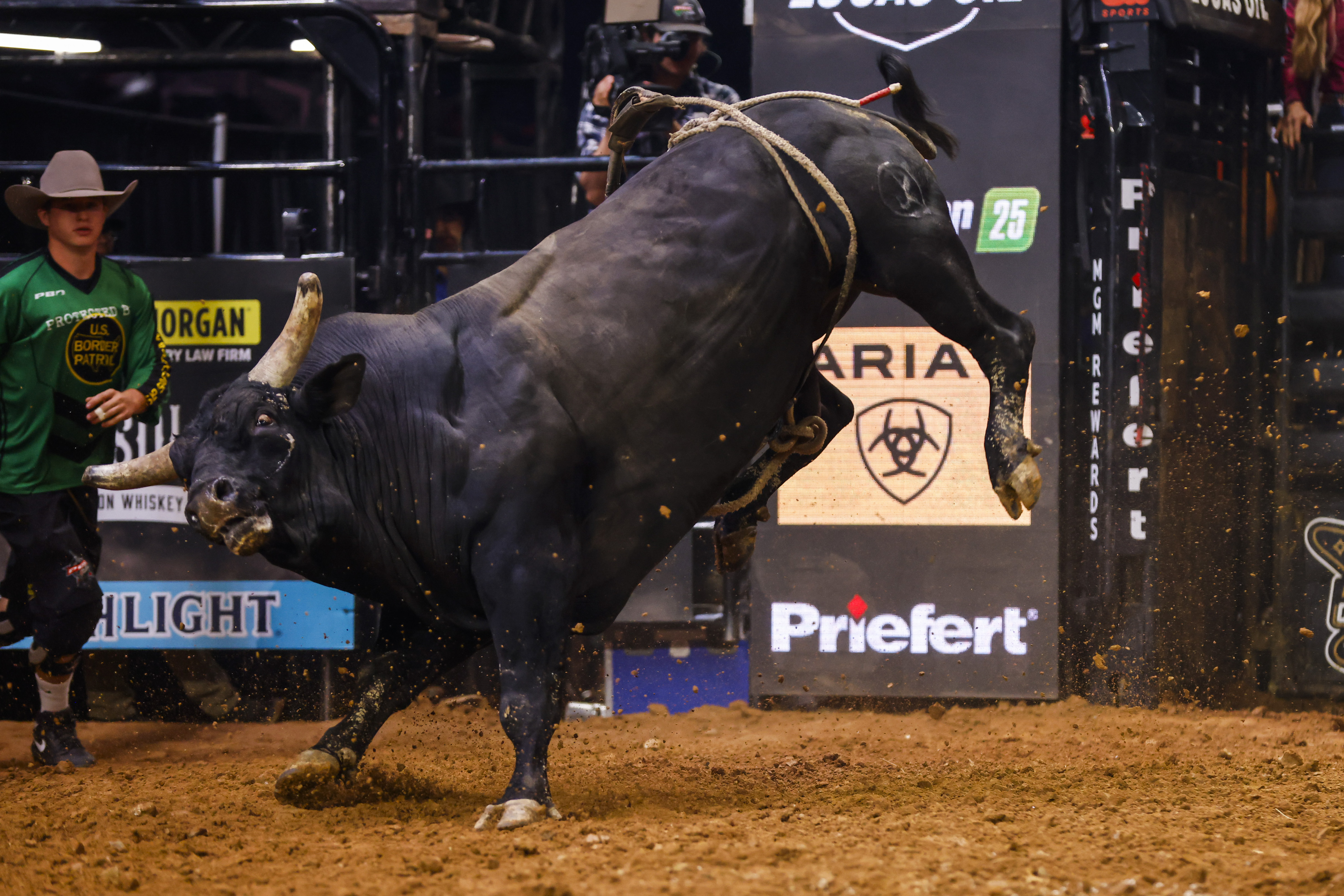
EXECUTIVE SUMMARY
From six-figure prize money to lucrative breeding deals, elite bucking bulls have become the stars of a booming, multimillion-dollar business.
Key Takeaways
- The million-dollar bull business: Forget the cowboys, the bulls are making big money, too.
- From six-figure prize money to lucrative breeding deals, elite bucking bulls have become the stars of a booming, multimillion-dollar business.
- Per PBR data, the top bull in each of the last six years has made six figur
Read Complete Original Article
Published originally on Yahoo Sports