An unsuspecting traveler trucking their way through a hiking trail would likely stop in bewilderment if they saw it: a nearly two-foot-long, Slinky-like contraption made of plastic and rubber, clambering forward like an inchworm. That confusion would shift to unease when scanning up and down its bendy, elephant-trunk-like body and seeing pairs of snapping claws at either end. Unabashed horror would inevitably take over as our traveler watches another one of the soulless Slinkies appear, inch toward the first one, and connect at the claws, creating one much larger, lifeless wiggly slug. All around, more clawed robots would close in from the forest and merge until they’d combined into a lizard-like mishmash of plastic and claws the size of a small bear. These clawed robots are, in fact, real and they are the latest creation coming from the Department of Mechanical Engineering at Colorado State University. Inspired by the unique, flexible strength of elephant trunks, the 3D-printed TeCoBots robots are an attempt to work around the usual rigid constraints of building a robot. The team used an approach called tensegrity, in which the cylindrical rods in the robot’s body are held in place by a web of tensioned cables rather than rigidly locked together. This makes it bendy, like a Slinky, so it can twist and turn around obstacles or collapse down on itself. In testing, a remote human operator was able to use the robot’s bendy body and gripper claws on either of its ends to traverse over a large branch outdoors. It can also roll over itself repeatedly, shimmy up a pipe, and slither like a snake. But as our unfortunate hypothetical hiker discovered, TeCoBot really shines when it works with others. Engineers designed the robots so that their claws can grasp onto another robot and merge. These modular robot links can move as one or operate independently of each other to complete more complicated tasks. In the study and accompanying videos, gaggles of chained TeCoBots work together to climb up a desk and grab a pen, open a sealed jar, or grab an object and carry it across a room. All of this, the researchers emphasize, has humanity’s best interest at heart. The robot’s flexible design could make them invaluable tools in search and rescue missions where they could squeeze into places rescuers can’t reach. One day, these teams of robotic slugs may work together to accomplish tasks unsuited for humans on spacecraft and extraterrestrial planets. “In the future, we can envision mostly autonomous teams of tens or even hundreds of them – attached through the claws—traveling to a location and then deploying for a specific purpose,” Colorado State University Associate Professor Jianguo Zhao said in a statement. “They are very adaptable to the situation and goals.” Details of the robot were published this week in the journal Nature Machine Intelligence. Inspired by nature’s Slinky Zhao and his colleagues started the project to fill some of the gaps in current robot hardware. Though many new types of machines are being built these days, most are still made from sturdy but rigid materials that limit their flexibility. Most robots also tend to prioritize either locomotion (moving) or manipulation (grabbing stuff), with few excelling at both. Like most human problems, nature already devised a solution long ago. In this case, the researchers looked to the remarkable combination of strength and flexibility in an elephant’s trunk. These marvels of evolution let the world’s largest land mammals both heft rocks weighing several hundred pounds and gently peel open bananas. That wide range and adaptability could come in handy for a robot. The device they ended up creating measured one foot 11 inches long, has a 4.3-inch diameter and weighs around 600 grams (1.3 pounds) without batteries, roughly the same as a fully loaded Italian sub. Each robot module is made of six carbon fiber rods and a continuous, stretchable, 3D-printed tension. This stretchy and bendy design means one robot can bend either direction, stretch up like an accordion or collapse down on itself. The team used an approach called tensegrity, in which the cylindrical rods in the robot’s body are held in place by a web of tensioned cables rather than rigidly locked together. Image: Adaptive Robotics Lab. Teamwork makes the claw work The claws at either end of TeCoBot are fundamental to how it can combine with its fellow slinky-bots. The grippers connect and lock onto each other, reducing the need for other connectors like magnets, which are more prone to mechanical failure. Once connected, each robot can offload certain physical stresses to the others to lighten its load, giving the whole system what the research team refers to as a kind of “embodied intelligence.” Working together, these linked robots can complete far more complicated tasks than any one of them could alone. In demonstration videos, the robots roll towards each other and connect to form one long robot that can more easily loop around a pipe. In another example, several more robots combine to form an H-shape, which then allows the entity to climb along a duct. The merged robots are still able to use the unlined claws at either end to precisely grab objects. The team demonstrated this by instructing a multi-robot TeCoBot chain to climb a desk, pluck a pen out of a container with its claw, crawl back down to the ground, and drop the pen into a trash can. “They can bend around to lift and carry different sized objects with their body or to navigate difficult terrain like a snake would,” Zhao said. An assortment of robots merged together and used team work to grab a pen off a desk. Image: Adaptive Robotics Lab. This actually isn’t the first time roboticists have turned to elephants for design choices. A previous entry called EleTac from a team out of Japan Advanced Institute of Science and Technology replaced the main sensors and camera normally in a robot grippers with essentially one massive integrated sensor able to “feel” an object’s texture. That approach, mirroring an elephant’s tactile trunk, resulted in a gripper that could hold a sponge and wipe down dirty plates and blindly feel for a pen buried beneath a layer of sand. Meanwhile, another team from the University of Hong Kong,created their own Aerial Elephant Trunk robot grippers and strapped them to the sides of flying drones, essentially giving them a floppy, grippy tail. Real samples of elephant trunk skin tissue have also been studied and used as a reference point for new surface material that could be used to make soft robots that are similarly tough and durable on one end but flexible and sensitive on the other. The post Robotic slugs with claws can fuse together to create one massive machine appeared first on Popular Science.
Robotic slugs with claws can fuse together to create one massive machine
PO
Popular ScienceBy Mack DeGeurin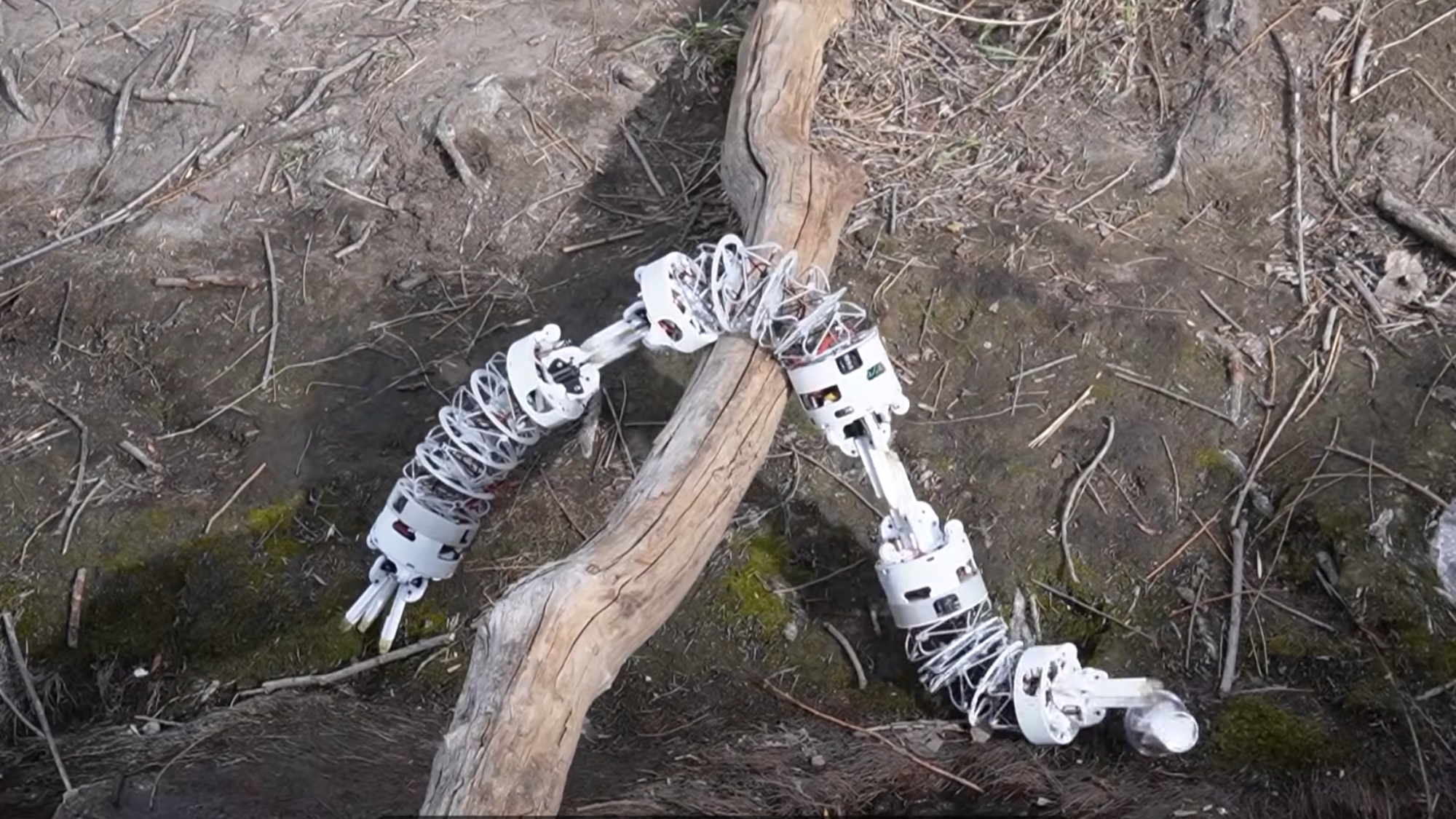
EXECUTIVE SUMMARY
The TeCoBots may squirm around future space ships. The post Robotic slugs with claws can fuse together to create one massive machine appeared first on Popular Science.
Key Takeaways
- Robotic slugs with claws can fuse together to create one massive machine.
- The TeCoBots may squirm around future space ships.
- The post Robotic slugs with claws can fuse together to create one massive machine appeared first on Popular Science.
Read Complete Original Article
Published originally on Popular Science