The next standard of handheld gaming continues with the Acer Predator Atlas 8, the striking 8-inch Windows handheld featuring the most powerful chips I've seen for handheld gaming on the go: the Intel Arc G3 Extreme. What really sets this big beauty apart from its rivals, though? It offers a lot for less than you'd think, and I'd be happy to ditch a gaming PC to play on this all day long. Having seen the Predator Atlas 8's potential back at Computex 2026, I was delighted to see it had met my expectations and gone further, from playing Star Wars: Galactic Racer on the couch to delving deeper into Gears of War: E-Day while travelling with frame rates pushing to 90 frames per second (FPS) at medium to high settings — thanks to Intel's XeSS graphics upscaling and frame generation tech. It's a marvel to play, only made better thanks to the sizeable 8-inch 1200p LCD display boasting a 120Hz variable refresh rate and the snappy TMR sticks and Hall Effect triggers. For $1,299 / £1,299? That's still pricey, sure, but not nearly as much as the equally powerful $1,799 MSI Claw 8 EX AI+. It's even the same price as the OLED-focused ROG Xbox Ally X20, but delivers even greater power. All that said, Acer clearly has to make some sacrifices, and they're evident. That includes the cheap-feeling D-pad and adjustable triggers that sometimes don't register input. And don't expect the magic of Intel's XeSS tech to work on a majority of games (including Halo: Campaign Evolved specifically in the Xbox app, despite it being supported, for some odd reason).In any case, the Acer Predator Atlas 8 is easily one of the best gaming handhelds you can buy right now. For a deeper dive on what to expect, read on. Acer Predator Atlas 8: Cheat SheetWhat is it? A big, stylish Windows gaming handheld with incredible performance to play the latest PC games on the move.Who is it for? Gamers looking for the ultimate on-the-move power for a reasonable price.What does it cost? The Acer Predator Atlas 8 is priced from £999 with Intel Arc G3 in the U.K. and from $1,299 / £1,299 for the Intel Arc G3 Extreme model. Got the cash to spend? You can also get a 32GB model for £1,499 in the U.K. We'll wait to see if these models will arrive on the U.S. side.What do we like? The mighty performance to play demanding PC games thanks to the Intel Arc G3 Extreme chip, the all-encompassing 8-inch display with bright, sharp visuals, the satisfyingly sturdy ergonomic feel, and high-end TMR sticks and Hall Effect triggers.What don’t we like? The D-pad isn't as clicky or as precise as modern controllers, the triggers sometimes don't register a button press (when adjusted), a few Windows 11 hiccups and XeSS 3 game support is still limited.Acer Predator Atlas 8: SpecsAcer Predator Atlas 8 (starting)Acer Predator Atlas 8 (tested)Price$999 / £999$1,299 / £1,299CPUIntel Arc G3Intel Arc G3 ExtremeRAM16GB LPDDR5x24GB LPDDR5xStorage512GB1TBDisplay8-inch FHD+ (1920 x 1200) LCD touchscreen | 120Hz VRR8-inch FHD+ (1920 x 1200) LCD touchscreen | 120Hz VRRPorts1x microSD, 2x Thunderbolt 4, 1x 3.5mm audio jack1x microSD, 2x Thunderbolt 4, 1x 3.5mm audio jackWireless connectivityWi-Fi 7, Bluetooth 6Wi-Fi 7, Bluetooth 6Dimensions11.7 x 5 x 2.2 inches11.7 x 5 x 2.2 inchesWeight1.79 pounds1.79 poundsAcer Predator Atlas 8: The UpsThe Acer Predator Atlas 8 couldn't have arrived in my hands at a better time. I had taken some time off to take care of a new addition to the family (a dog, if you must know), and that meant having plenty of time to build new routines and, of course, kick back. But that all had to be done away from my gaming PC, and my backlog has been piling up (it's been a phenomenal year of great games, and that's pre-GTA VI!).Thankfully, the Atlas 8 arrived to clean up that backlog, and it's (mostly) been an absolute treat.Big, bold and portable(Image credit: Future / Tom's Guide)With a name like "Atlas," it's almost a given that this Windows gaming handheld had to be quite big in size. On paper, that should be counterproductive for a portable gaming handheld, but Acer fine-tuned the Predator Atlas 8 to make it a sizeable machine that's equally comfortable to hold, too. At 11.7 x 5 x 2.2 inches and weighing 1.79 pounds, this is one of the biggest Windows handhelds ever, and that includes comparing it to the famously big Lenovo Legion Go 2 (11.64 x 5.38 x 1.66 inches, 2.09 pounds). At the very least, it isn't nearly as heavy. But when it comes to the Asus ROG Xbox Ally X20 (11.8 x 4.8 x 2 inches, 1.67 pounds) or MSI Claw 8 EX AI Plus (11.6 x 5.1 x 1.9 inches, 1.7 pounds), it shows Acer couldn't quite trim as much fat off the Atlas 8's bulky design. Realistically, though, there isn't that much difference, and it's still an ergonomically pleasing handheld once put in hands. (Image credit: Future / Tom's Guide)From the contoured grip with anti-slip textures to the large layout that rest easy on your palm, the Predator Atlas 8 is great to hold while play all types of gaming genres, whether than be first-person precision in Halo or fast-paced racing in Forza Horizon 6 or Star Wars: Galactic Racer. While I'd prefer to have an armrest to lay my elbows on while playing, as it is heavier than, say, a Nintendo Switch 2 (10.7 x 4.5 x 0.5 inches, 1.18 pounds), it's still comfy to use. Now, some may find this too bulky and heavy to handle for longer sessions, but setting up in a comfortable position on a couch can fix that issue. (Image credit: Future / Tom's Guide)Another major highlight is the 8-inch FHD+ (1920 x 1200) LCD touchscreen with 120Hz VRR. It's big enough to show off great detail and depth in the games I'd play, which is vital in titles like Star Wars: Galactic Racer and even Gears of War: E-Day, and bright enough so I could still see colorful visuals even in sunny environments. With its nicely color-coded face buttons and sticks with RGB-lit rings, it's a great-looking handheld to bring along. I also really appreciate the satisfying-feeling TMR (Tunnel Magnetoresistance) joysticks and Hall Effect triggers, which make stick drift virtually nonexistent and make each touch feel precise. While the rear macro buttons don't quite feel as premium as the rest, I'm a fan of their placement, along with their customizability for what you need them to do. A fantastic, great-feeling layout goes a long way in a gaming handheld, and the Atlas 8 nails the design. There's still a lot to be desired (more on that later), but I was always excited to pick this up to start gaming. The power to (PC) game(Image credit: Future / Tom's Guide)Ever since Intel revealed its gaming handheld-specific Intel Arc G3 Extreme, we've seen just how far this chipset has taken portable gaming. It's an incredible chip with plenty of raw power, brought to new heights with Intel XeSS upscaling and frame generation. The Acer Predator Atlas 8 takes that power and runs with it — and it made games I play look far more playable than I'd initially thought.As in the MSI Claw 8 EX AI+, the Intel Arc G3 Extreme is a wonder for portable power. That's both for graphics and processing power, mind you. AMD's Ryzen Z2 Extreme may have made huge strides to deliver great handheld performance in the ROG Xbox Ally X, but Intel's G3 Extreme takes performance up a notch by a considerable amount. And this shows in every 3DMark test I threw at it. Performance BenchmarksAcer Predator Atlas 8 (Intel Arc G3 Extreme)MSI Claw 8 EX AI+ (Intel Arc G3 Extreme)Asus ROG Xbox Ally X (AMD Ryzen Z2 AI Extreme)3DMark Fire Strike11,56312,3589,1413DMark Time Spy6,1556,5344,0333DMark Steel Nomad1,0641,4256093DMark Port Royal (ray tracing test)N/A3,5441,999Geekbench (single core/multicore)2408 / 141162492 / 12,5502,788 / 12,883Interestingly, despite having the same chipset, the Predator Atlas 8 still fell short of the Claw 8 EX AI+. But that's due to the 24GB of DDR5X RAM my review unit came with compared to the 32GB of DDR5 RAM the Claw 8 EX AI+ boasts. As you can see, there's not a major difference, but do know you can grab a 32GB Atlas 8 model, and it's still less than MSI's handheld. In any case, even if you wanted to hook up the Atlas 8 to one of the best monitors to get some work done in desktop mode, you can, thanks to the performance this chip offers. To put its Geekbench numbers into perspective, the Atlas 8 is well beyond something like the Dell XPS 13 (2026), and is actually nearly on par with a MacBook Air M4. Now that's impressive. But this is made to play games, and it has plenty of power to do so. Even with its raw performance, the Atlas 8 offers great frame rates in games like Cyberpunk 2077 at 1080p with High settings and way more in classic titles, including Shadow of the Tomb Raider. Reminder: this is without Intel XeSS upscaling or frame gen. Gaming BenchmarksAcer Predator Atlas 8 (Intel Arc G3 Extreme 35W)Asus ROG Xbox Ally X20 (AMD Ryzen Z2 AI Extreme 35W)MSI Claw 8 EX AI+ (Intel Arc G3 Extreme 35W)Black Myth: Wukong (1080p Cinematic)17 FPS11 FPS14 FPSCyberpunk 2077 (1080p Ray Tracing High)24 FPS8 FPS17 FPSShadow of the Tomb Raider (1080p High)83 FPS31 FPS66 FPSThis outclasses what the ROG Xbox Ally X20 (and ROG Xbox Ally X, having the same chip) can offer, and surprisingly even beats the Claw 8 EX AI+ by a few frames. For the price, this is an amazing feat, and well worth the performance alone. That's especially true for older classics, too, as you can get over 80 FPS in the likes of Shadow of the Tomb Raider. Of course, it wouldn't be enjoyable to play the latest titles at those measly frame rates. But even at Medium settings in Black Myth: Wukong, you can get a solid 47 FPS, and that's at 1200p resolution. With a bit of tinkering in the settings (like a resolution drop or some low settings), you can get this running at 60 FPS without frame gen needed. Now, once I started bringing Intel XeSS upscaling into the fold, that's when you can really see the Atlas 8 work its magic. Think Cyberpunk 2077 at 1200p with frame rates reaching past 90 FPS, and that's with High settings and ray tracing turned on. Similarly, Star Wars: Galactic Racer at 1200p with Medium quality and Balanced resolution scaling was hitting over 70 FPS, which is needed for that type of fast-paced gameplay. Even Gears of War: E-Day performed brilliantly, whether I wanted a solid 60 FPS with Quality upscaling or closer to 90 FPS and up for faster performance. As you can tell, there's a lot the Intel Arc G3 Extreme can handle, especially with XeSS tech to back it up (where it's supported). If you're after a gaming powerhouse for the road, the Acer Predator Atlas 8 is up to the challenge. Sipping on battery(Image credit: Future / Tom's Guide)Despite the power the Predator Atlas 8 boasts, this Windows handheld has the battery life that can see you through gaming sessions that last hours — when you need it to. Through the PredatorSense menu on the Atlas 8, Acer made it easy to switch between power wattage modes, including Quiet (25W), Balanced (30W) and Turbo (35W). But you can also manually change power from 10W all the way up to 40W (and up to 65W for short bursts of power, even though this isn't recommended by the system).All of this to say you can have the Atlas 8 utilize a lot of power to push performance further, or have it sip on battery for less demanding games. The end result is long-lasting battery life, reaching nearly 4 hours in testing. Battery Life3DMark gaming battery life test result (hh:mm)Acer Predator Atlas 8 03:48MSI Claw 8 EX AI+04:10Asus ROG Xbox Ally X02:56This isn't quite as long as the MSI Claw 8 EX AI+, but it's nearly a full hour longer than what the ROG Xbox Ally X offers. It's nice to see handhelds now going past the 3-hour mark, as I could now get a proper gaming session in without needing to be tethered to a charger. During real-world gameplay, I saw the Atlas 8 last 1 hour and 35 minutes while playing Gears of War: E-Day, and 1 hour and 41 minutes in Cyberpunk 2077, both at 35W. Switching to 25W while still getting good performance, Star Wars: Galactic Racer lasted 2 hours and 24 minutes. Not bad for those types of demanding titles! But when it comes to less-demanding games like Hades 2 or Marvel Cosmic Invasion, with only 10-15W, this only went down to 85% in an hour. That's a long time to game!Usually, I'd imagine powerful performance results in incredibly short battery life. But more and more, we're seeing this isn't the case, and the Predator Atlas 8 is a fine example of this. Acer Predator Atlas 8: The DownsAs much as I've enjoyed playing on the Acer Predator Atlas 8 any chance I got, it's still held back by a few sacrifices being made, which I imagine were done to keep the price down. That, and there are still some Windows 11 hiccups here and there (although, that's hardly surprising). Still a chunky handheld(Image credit: Future / Tom's Guide)While the Acer Predator Atlas 8 feels comfy in the hand thanks to its ergonomic grips, anti-slip texture and satisfying heft, it's still quite a chunky piece of tech. Not everyone will appreciate holding nearly 1.8 pounds for hours on end, especially when its rivals are lighter. This wasn't a major problem for me, especially when I had my elbows resting on the armrests of my office chair or the side of the couch. That said, the aches were starting to creep in while traveling. It's a big handheld to deliver a large 8-inch display and comfy grips, and I wouldn't expect otherwise from a device named "Atlas." Just know what you're signing up for. At the very least, you can drop to the Predator Atlas 7 for a smaller 7-inch design. Stick with the sticks(Image credit: Future / Tom's Guide)Bringing TMR joysticks for precise, good-feeling controls that are stick drift-resistant, along with Hall Effect analog triggers for pleasing responsiveness, is hugely welcome, but the D-pad seems to have been thrown in without much thought. There's no tactile feel or satisfying actuation feedback for each direction here, just what feels like one big mushy button. For the majority of games, this isn't a huge deal, as you'll be using the analog sticks anyway. But for classic titles, fighting games, Metroidvanias and more, having a great D-pad makes a world of difference. I know this, as while playing Guile in Street Fighter 6, buttons just couldn't reliably register a charging-type "Sonic Boom." With how smooth the D-pad feels, I suppose it did make the input for Ryu's "Hadoken" somewhat easier, but never consistent. It's also worth noting that the Predator Atlas 8 comes with adjustable trigger modes, which let you change the L2 and R2 triggers from full-travel analog press to shorter travel for faster inputs. This is a great addition, but I noticed that switching to a shorter trigger meant some actions didn't register (such as shooting a weapon). This could be a minor issue with my unit, but also something to keep aware of. Otherwise, switching back to full travel didn't make a huge difference anyway. Some limitations(Image credit: Future / Tom's Guide)Microsoft's Xbox Mode has made a world of difference on Windows handhelds to deliver more of a console-like experience. But it still has some issues to iron out. While I love bringing up the Xbox overlay to quickly switch gaming clients, check out my library of games, change settings and also see performance (that includes FPS), sometimes the overlay simply wouldn't come up unless I pressed the menu button a few times, or never at all until I switched apps. The same thing would happen when pressing the power button to put it to sleep — sometimes it powered down immediately, sometimes it didn't. I also appreciate being able to switch to desktop mode to, essentially, use this like a proper PC. But again, nuisances like the keyboard not coming up when trying to find a game on Steam or the Xbox app being open but not showing up on screen make it all frustrating. Windows 11 on handhelds still isn't as clean to use as, say, SteamOS, but it's far from what it was. Also, like the MSI Claw 8 EX AI+, Intel's XeSS 3 support in games is still limited. While games like Star Wars: Galactic Racer, Assassin’s Creed Black Flag Resynced and Forza Horizon 6 support this for Multi-Frame Generation (MFG), many of the biggest titles still don't. In fact, Halo: Campaign Evolved does support Intel XeSS 3, but it's "not available for Microsoft Store games," strangely. So, that means I would have to buy this on Steam to get access instead. That's annoying. The Intel Arc G3 Extreme chip is still plenty powerful, and more games will be supported in the future, but there are some limits to know about. Acer Predator Atlas 8: Verdict(Image credit: Future / Tom's Guide)The Acer Predator Atlas 8 has been hard for me to put down, and that should say plenty about how much I've enjoyed playing all the latest PC titles on this mighty machine. From the outstanding performance the Intel Arc G3 Extreme chip delivers in even demanding games to the big, bright 8-inch display to get stuck into, the Atlas 8 is a fantastic gaming handheld that I've been happy to use virtually anywhere instead of my gaming PC. What sets it apart from its rivals? It's price-to-performance ratio. It's more affordable than the MSI Claw 8 EX AI+ while delivering the same performance, and it's the same price as the ROG Xbox Ally X20 while being more powerful. But design-wise, Acer's handheld doesn't quite match all the premium trimmings of its competition. In any case, that doesn't take away from the Acer Predator Atlas 8 being the best gaming handheld I've tested, so if you're looking for the ultimate gaming experience on the move, this will certainly fit the bill.
I spent 2 weeks playing the Acer Predator Atlas 8, and this big gaming handheld (almost) made me ditch my PC
TO
Tom's GuideBy Darragh Murphy 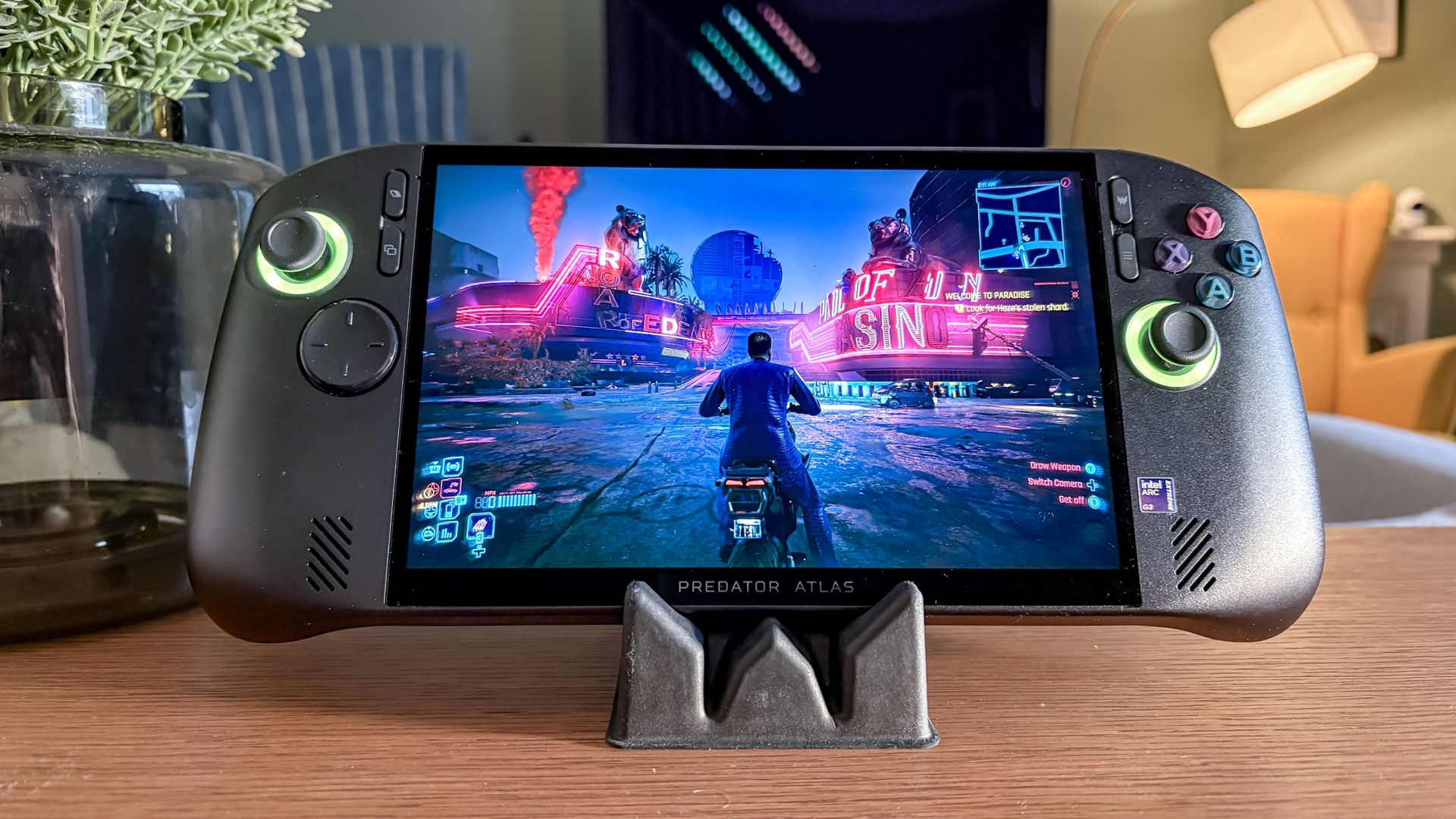
EXECUTIVE SUMMARY
The Acer Predator Atlas 8 finally delivers ultimate gaming handheld power with the might of Intel's Arc G3 Extreme chip at a price that makes sense, but there are a few features that left me wanting more.
Key Takeaways
- I spent 2 weeks playing the Acer Predator Atlas 8, and this big gaming handheld (almost) made me ditch my PC.
- What really sets this big beauty apart from its rivals, though?
- It offers a lot for less than you'd think, and I'd be happy to ditch a gaming PC to play on this all day long.
Read Complete Original Article
Published originally on Tom's Guide