In an increasingly volatile world shaped by extreme weather, power outages and cyberattacks, being prepared for an emergency is no longer seen as paranoia. Instead, governments are actively encouraging the public to stock up on emergency supplies to last for three days.At the end of October, the U.K. government launched its "Be Ready” campaign, urging households to take to small steps to prepare for emergencies. It was unsettling to hear, but the public took it in its stride without pressing the panic button. While I half expected grocery aisles to descend into chaos, the public’s response has been remarkably calm and considered. People are clearly listening, but without the fear. According to research by Worldpanel by Numerator and reported by the BBC, following the campaign, sales of hand sanitizer, bottled water, and tinned and jarred items rose by 83%, 67%, and 37%, respectively, indicating that hygiene is top of the agenda.The story is slightly different in the U.S., where the Federal Emergency Management Agency (FEMA) launched its Ready Campaign in 2003, empowering and educating Americans to “prepare for, respond to and mitigate emergencies and disasters.”Although the U.S. is ahead in urging households to assemble an emergency kit, both share the same remit: encouraging people to have sufficient supplies for a few days.What to add to your emergency grab bag(Image credit: Shutterstock)Emergency Supply ListU.K. ChecklistU.S. ChecklistIn the U.K., households are being urged to keep three days’ worth of food and water on hand. That equates to three liters of drinking water per person, per day, excluding water for washing. As for food, the focus is on non-perishables that don’t require refrigeration or cooking if the power cuts out. Tinned meat and fish, vegetables, fruit and nuts are ideal, but do ensure you have a manual can opener.The “Be Ready” campaign also recommends gathering essentials like torches, warm clothing, medical and hygiene products and cash in a mix of coins and notes. But there’s another item to add to your emergency kit that will keep you connected if the networks go down. It might seem archaic, but a wind-up radio remains the most reliable lifeline for emergency broadcasts when the grid fails. And it’s the first item I added to my grab bag. Stay connected(Image credit: Amazon)When the power goes out and the networks go down, a wind-up radio keeps you connected. That’s why it was the first item I bought on the back of the U.K. “Be Ready” campaign advice. There are plenty of wind-up radios to choose from online, but I opted for an all-singing-all-dancing version that offers some extra benefits. My emergency Multi-Purpose Crank Radio, is $37.99 at Amazonand comes in a choice of four bright colorways — green, blue, orange and red. It’s bright enough to stand out if you need to find it in a hurry!Multi-purpose crank radio: $37This emergency radio is designed for power outages and other emergencies. It can be manually charged by the hand crank or the solar panel, and it also has a compartment for AAA batteries. In addition to tuning into emergency radio broadcasts, it features a torch, a reading light and an emergency alarm. View DealSo much more than a radio(Image credit: Amazon)On first inspection, you’ll notice it has a solar panel on top, but aside from relying on the sun to power it, it also has a wind-up crank that pulls out from the back and a battery compartment that fits 3 x AAA batteries. If you’re relying on manual power, you’ll need to turn the crank for 3-5 minutes to activate the internal battery for initial use — it's like a mini workout! (Image credit: Future / Camilla Sharman)Dig a little more into the details, and you’ll find the crank needs to be turned at 130-150 rpm for power to be generated — taking 7 hours until it’s fully charged. I may be handing this one over to the Tom’s Guide fitness teamAmazonAmazonIt also has two light options. Lift up the solar panel to reveal an LED reading light, or press the adjacent button to illuminate the flashlight. What’s more, if the light isn’t enough to help you find your way, or someone else find you, it has an SOS alarm on the base of the gadget — just cover your ears before you try it out! AmazonAmazonOn the same switch as the SOS alarm, you’ll also find the charging button, which you’ll need to select to recharge your phone. And when you do charge it up, there’s a USB port on the side by the antenna, and it includes a micro USB cable for connecting your devices. On the underside, you can also access the 2000 mAh rechargeable battery, by removing two small screws on the base.I nearly forgot about the strap. It comes with a lanyard and carabiner, so you can attach it to your clothing and keep it on your person when needed. Depending on the size of your pockets, it could easily be pocket-sized. It measures 2.91 (h) x 6.18 (w) x 2.09 (d) inches.Tune in(Image credit: Amazon)Beneath all of these extra functions, it is still, first and foremost, a radio. While that makes it a prehistoric relic to my children, I’m a child of the 70s and grew up relying on a radio for the latest hits.Switch to radio mode by selecting 'LI-ION' on the front. At the side of the radio, you’ll find the antenna; swivel it around and extend it for a better signal. Then select the required bandwidth; you can choose WB, FM or AM. The circular knobs control the volume (which also acts as the on/off button) and tuning.As you get close to a station, a small green light appears on the tuning panel and stays on once a channel is properly selected. If needed, the radio gives you access to NOAA weather broadcasts and keeps you informed with emergency alerts and local information.My verdictI wouldn’t recommend running the radio, flashlight, reading light and SOS alarm simultaneously, but it’s one small gadget I’d recommend adding to your emergency pack. It’s intuitive to use, small to store, and a mini powerhouse.More from Tom's GuideI audited my home for a 3-day blackout: 5 critical things I completely missedThe 4 emergency phone tweaks that keep your battery alive in a power outageDon't get caught out: here's everything you need to put in your home emergency kit
Forget batteries: Why an emergency radio was the first prep item I bought
TO
Tom's GuideBy Camilla Sharman 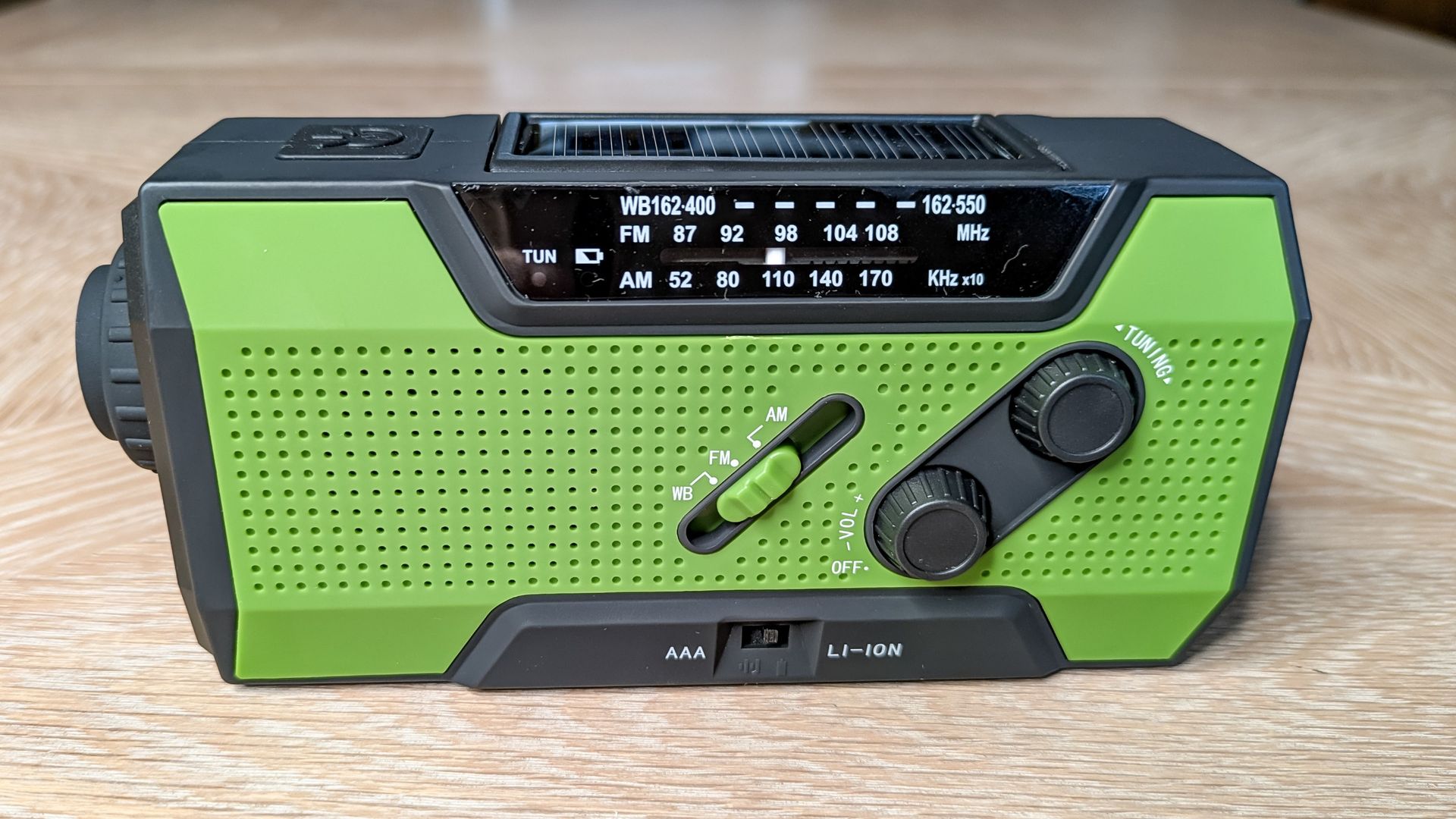
EXECUTIVE SUMMARY
I’m not a prepper, but I have added one item to my emergency kit: Why this $36 radio is a good start.
Key Takeaways
- Forget batteries: Why an emergency radio was the first prep item I bought.
- I’m not a prepper, but I have added one item to my emergency kit: Why this $36 radio is a good start.
- In an increasingly volatile world shaped by extreme weather, power outages and cyberattacks, being prepared for an emergency is no longer seen as paranoia.
Read Complete Original Article
Published originally on Tom's Guide