Fiona Goodall/Getty ImagesDid New Zealand just witness a first-past-the-post election under MMP? There was a time when elections were determined by results in a handful of marginal electorates. Since the introduction of MMP in 1996, however, overall voter support for individual parties has been the deciding factor. This year, the old days seem to have returned. The outcome could well hinge on a small number of close-run seats – just like pre-proportional elections used to. Put aside questions about who will hold the balance of power when final results are announced on November 27, or whether Christopher Luxon will go back on his word and negotiate with the Opportunity Party if he has to. Deeper down, the tectonic plates of New Zealand politics are drifting. Rumblings in the electoral system The next parliament is going to be the largest in history. While it generally numbers between 120 and 123 MPs, the overhangs created on the left and right are so large it could have as many as 131. This will be the sixth overhang since MMP was adopted, but two things set this one apart: its size and its impact. The discrepancy between the parties’ share of the vote and their share of all parliamentary seats will be distorted. That means it will affect the formation of the next government. Without the overhang, provisional results would have given both National and Labour roughly 36 seats. But because National’s performance in the electorates exceeded its showing on the party vote, it currently has 42 seats. This means National holds 32% of seats in a 131-member parliament to Labour’s 27.5% – even though the parties are neck-and-neck on the party vote. This disconnect between vote share and seat share is the sort of thing that fuelled New Zealanders’ rejection of the old first-past-the-post system. In 1978 and 1981, for instance, Labour secured more votes than National overall but lost the election because it won fewer seats. The similarities with the 2026 election are uncanny: on provisional results Labour’s lead over National on the party vote is 3,650 votes; in 1981, Labour’s lead was 4,122. Negatives for National We’ve seen this coming. Both the 2012 MMP Review and the 2023 Independent Electoral Review addressed the overhang issue. Each recommended abolishing the provision for overhang seats – and on both occasions National (or National-led) governments chose not to act on those recommendations. While National would rather return to office than to opposition, the election result presents the party with significant challenges. For one thing, it is now an electorate-only party: voters like the party’s individual MPs more than they like the party itself. That has never happened to a major party before in the MMP era, and poses a strategic conundrum for National: does it swing further right to retake the votes it has shed to ACT and New Zealand First, or return to the ground it held when it was a broad-based party of the centre-right? It’s not clear what influence the vote-splitting campaign to deliberately engineer an overhang had on the results. But there was a reason Luxon called strategic voting “the opposite of clever”: it reduces the party’s influence in coalition negotiations and slashes its presence in the next cabinet. National supporters have also effectively deprived their own party of three of its most senior and hard-working ministers. Nicola Willis, Paul Goldsmith and Chris Bishop carry 18 ministerial portfolios between them (some of which will go to ACT or New Zealand First ministers if the same coalition government is eventually returned). And should National voters develop a taste for strategic voting, the party won’t be able to rely on its list to balance the slate of candidates selected by the party’s electorate committees. Local concerns and national priorities don’t always align. Political parties use their lists to create the desired mix of candidates on the basis of competence, experience, gender, ethnicity and so on. National’s capacity to do this has now been hamstrung. Spare a thought for its campaign manager at the next general election. Read more: What really drove NZ’s election overhang and what can be done about it Positives for National On the other hand, National’s performance in the electorates could be a potential long-term advantage. There is a strategic case to be made for focusing on electorate contests (as Te Pāti Māori has done in the Māori electorates, and as some German parties do) – especially if population growth causes the number of general electorate seats to rise relative to the number of list seats. At the first MMP election, there were 65 electorate and 55 list seats; last week (and pre-overhang), there were 71 electorate seats and just 49 list seats. Unless that ratio is fixed – also recommended by the 2023 Independent Electoral Review – the number of electorate seats will keep increasing as the population grows. In such circumstances, a party with a strong electorate presence (National) could do well, especially if it were to align itself with other parties (ACT is the obvious choice here) that concentrate on the party vote. In this respect, National is in a much stronger position than Labour, whose electorate vote is more concentrated across fewer seats. Labour’s electorate vote is also shrinking as Labour-leaning Māori voters shift onto the Māori roll. Fixing the system There are ways to address the overhang problem. Most obviously, the electoral law could be amended to either offset the consequences of overhangs or remove them entirely. Remedies might include abolishing the “coat-tail” provision that exempts parties from the 5% threshold for entering parliament if they win a single electorate seat, bringing in more candidates than their overall vote would otherwise allow. The party vote threshold could be lowered, and the ratio of electorate-to-list seats fixed at 50-50, as originally recommended by the 1986 Royal Commission on the Electoral System. National-led governments have passed up the opportunity to make these changes before. It seems unlikely a new one will break with precedent. Richard Shaw does not work for, consult, own shares in or receive funding from any company or organisation that would benefit from this article, and has disclosed no relevant affiliations beyond their academic appointment.
Disproportional representation: what National wins and loses from the overhang
TH
The Conversation - AustraliaBy Richard Shaw, Professor of Politics, Te Kunenga ki Pūrehuroa – Massey University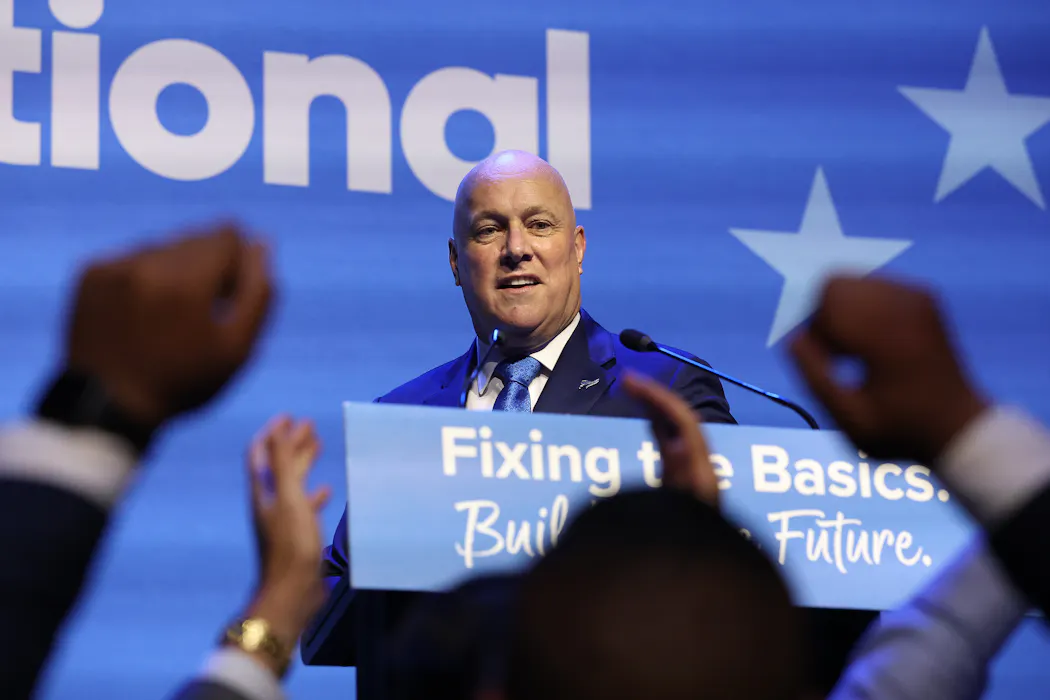
EXECUTIVE SUMMARY
Fiona Goodall/Getty Images Did New Zealand just witness a first-past-the-post election under MMP? There was a time when elections were determined by results in a handful of marginal electorates. Since the introduction of MMP in 1996, however, overall voter support for individual parties has been the deciding factor. This year, the old days seem to have returned. The outcome could well hinge on a small number of close-run seats – just like pre-proportional elections used to. Put aside questions a
Key Takeaways
- Disproportional representation: what National wins and loses from the overhang.
- Fiona Goodall/Getty Images Did New Zealand just witness a first-past-the-post election under MMP?
- There was a time when elections were determined by results in a handful of marginal electorates.
Read Complete Original Article
Published originally on The Conversation - Australia